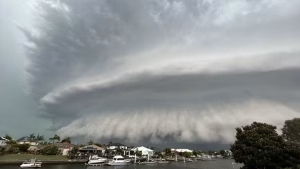
Wet Wet Wet: Why the Weather Feels Wetter Than Ever
When you live somewhere long enough, you stop checking forecasts and start noticing patterns.
The smell of the air.
How fast the ground dries.
Whether sunrise feels possible or pointless.
And lately — in Bali, across Southeast Asia, and increasingly around the world — everything just feels… wetter.
The land is soaked. The water runs off instead of sinking in. Wet seasons start earlier, end later, and arrive with less patience than they used to.
When I first arrived in Bali, there were stretches — two or three years at a time — where the wet season barely made an impression. Yes, there was rain, but it arrived politely. Mornings still gave you sunrises. Days still felt tropical, not heavy. The rhythm made sense.
Slowly, almost quietly, that rhythm changed.
The rains came earlier. Stayed longer. Fell harder.
Sunrises became rare guests instead of daily rituals.
The wet season stopped being a season and started feeling like a state.
And once you notice it here, you can’t unsee it elsewhere.
Is This Just a Cycle — or Something Bigger?
The obvious question is why.
Is this just a natural climate cycle doing what cycles do? Or is it a response to broader, messier forces at play?
The honest answer is probably both.
Earth’s climate has always moved in waves — El Niño, La Niña, monsoon oscillations, ocean temperature shifts. Southeast Asia, in particular, lives at the mercy of warm seas and atmospheric pressure changes. A slight variation in ocean heat can mean a lot more water falling from the sky.
But there’s also a second layer now — one that’s harder to ignore.
Warmer oceans hold more energy.
Warmer air holds more moisture.
When that moisture releases, it doesn’t drizzle — it dumps.
This isn’t just a Bali thing. Europe floods. Australia swings between drought and deluge. The US sees “once in a century” rain events happening every few years. Seasons are blurring, stretching, overlapping.
What used to be predictable is now… enthusiastic.
Why It Feels Worse Than Before
Part of why the rain feels more intense isn’t just the amount — it’s what the land does with it.
Urban development replaces soil with concrete.
Deforestation reduces absorption.
Overworked land compacts and sheds water instead of drinking it.
So rain that once soaked in now runs off, pooling fast, flooding quickly, disappearing nowhere. It creates the impression of more rain even when totals aren’t dramatically different — though in many cases, they actually are.
The weather hasn’t just changed — the environment’s ability to cope with it has too.

A Global Shift, Experienced Locally
Living in Southeast Asia makes these changes impossible to ignore. The tropics amplify everything. Heat, humidity, rainfall — there’s no subtle mode.
But talk to friends elsewhere and the story echoes back:
- Winters that don’t feel like winters
- Summers that overshoot the mark
- Rain arriving out of season, in bulk
- Old patterns quietly retiring
The weather we grew up trusting is no longer taking calls.
So… What Do We Do With That?
Here’s the unsatisfying but honest truth:
This is where we are.
Whether you call it climate change, climate variability, natural cycles under pressure, or some uncomfortable combination of all three — the outcome is the same. The weather is changing faster than our expectations.
We can argue causes endlessly. We probably will.
But daily life doesn’t wait for consensus.
So instead, we adapt.
We adjust routines.
We stop promising ourselves dry seasons that no longer exist.
We learn to work with cloud cover instead of fighting it.
We appreciate the sun when it shows up — and stop resenting the rain when it doesn’t.
I still hope for more sun. Of course I do.
I still miss reliable mornings and postcard-perfect skies.
But I also accept that rain is now part of the deal — not a temporary inconvenience, but a new normal.
Wet is wet.
It is what it is.
And once you stop arguing with the sky, you get on with it.