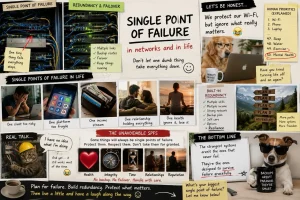
Single Point of Failure
A few years ago, I was troubleshooting an internet outage.
One tiny little device failed… one tiny 20c network connector….
And suddenly, an entire office of people couldn’t work.
Phones dead.
Emails gone.
Meetings cancelled.
Coffee consumption doubled.
Classic Single Point of Failure.
In networking, an SPF is exactly that — one thing breaks, and everything connected to it falls over like a drunk tourist on a Bali scooter after two Bintangs too many.
The funny thing?
Life works exactly the same way.
Some people build their entire happiness around one person.
One income source.
One app.
One client.
One social media account.
One battery charger they swear they left “right there”.
Then one tiny failure happens…
Boom.
Existential buffering wheel.
The internet solved this years ago with redundancy.
Multiple cables.
Backup routes.
Failover systems.
Cloud replication.
Secondary DNS.
Battery backups.
Basically:
“Don’t let one dumb thing destroy the whole system.”
Honestly, that’s pretty solid life advice too.
Have multiple ways to earn money.
Multiple ways to stay healthy.
Multiple friendships.
Multiple hobbies.
Multiple plans.
Not because you’re paranoid.
Because eventually, something will fail.
And when it does, resilience beats panic every single time.
That said… some things in life will always remain unavoidable SPFs.
Your health.
Your integrity.
Your reputation.
Your time.
There’s no RAID array for your liver.
No cloud backup for 10 wasted years.
No hot-swappable replacement for trust once you destroy it.
That’s where the humorous seriousness kicks in.
We spend thousands protecting our Wi-Fi network…
Then completely ignore sleep, stress, relationships, or burnout.
We install surge protectors for electronics while emotionally free-running naked through lightning storms.
Humans are weird like that.
Maybe the goal isn’t eliminating every Single Point of Failure.
Maybe it’s simply knowing which ones deserve protection…
and which ones deserve a backup plan.
Because whether it’s internet infrastructure or life itself:
The strongest systems aren’t the ones that never fail.
They’re the ones designed to survive failure gracefully.