From Factory Floors to a Global Digital Revolution
Quick Read TL;DR
QR codes started life in Japan in 1994, helping car manufacturers track components more efficiently.
For years, they were useful but hardly revolutionary.
Then COVID changed everything.
Suddenly, QR codes were everywhere. Restaurant menus, check-ins, tickets and contactless payments all became part of everyday life. What had been a niche technology became something millions of people understood almost overnight.
But the really interesting story is what happened next.
QR codes have become a gateway into the global digital payment economy.
In Indonesia, QRIS has made QR payments much simpler for local businesses. And now QRIS is increasingly connecting with payment systems in other countries, including Malaysia, Thailand, Singapore, Japan and South Korea. Though this is a double-edged sword with a pure cash-grab and control aspect from the Indonesian government
For a small business in Bali, this could mean something significant: an international visitor may be able to pay using their familiar banking app without needing local cash or a local bank account.
Behind the little black and white square is a much bigger shift towards interconnected international payment networks.
QR codes aren’t just about scanning anymore.
They’re becoming part of the infrastructure connecting local businesses, travellers and global money.
.
Remember When…..
Remember when scanning a little black and white square with your phone seemed like a bit of a gimmick?
You might have used one to visit a website, download an app or check out a product. Useful, perhaps, but hardly revolutionary.
Then COVID arrived.
Suddenly, those little squares were everywhere. Restaurant menus became QR codes. Health declarations moved online. Event tickets appeared on our phones. Businesses that had relied on cash began displaying codes that allowed customers to pay without handing over a banknote.
And something interesting happened.
 A technology originally developed to track car parts became one of the building blocks of the modern digital economy.
But COVID was only the beginning of the story.
Today, QR codes are helping connect payment systems across international borders, making it easier for travellers to pay overseas and giving small businesses access to digital payment technology that would once have been expensive or complicated to implement.
Living in Asia, I see how relevant this has become. From small warungs and local coffee shops to hotels, markets and tourism businesses, digital payments are changing how money moves.
So, how did we get here? And what might the next chapter look like?
What Exactly Is a QR Code?
QR stands for Quick Response.
A QR code is a two-dimensional barcode that stores information in a pattern of black and white squares. A smartphone camera or other scanning device can read that pattern and interpret the information it contains.
Unlike a traditional barcode, which generally stores information in one dimension, a QR code can hold considerably more data in a compact space.
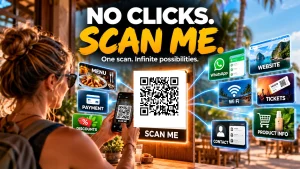
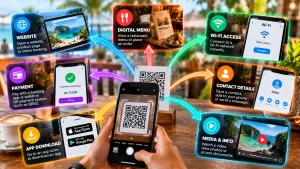
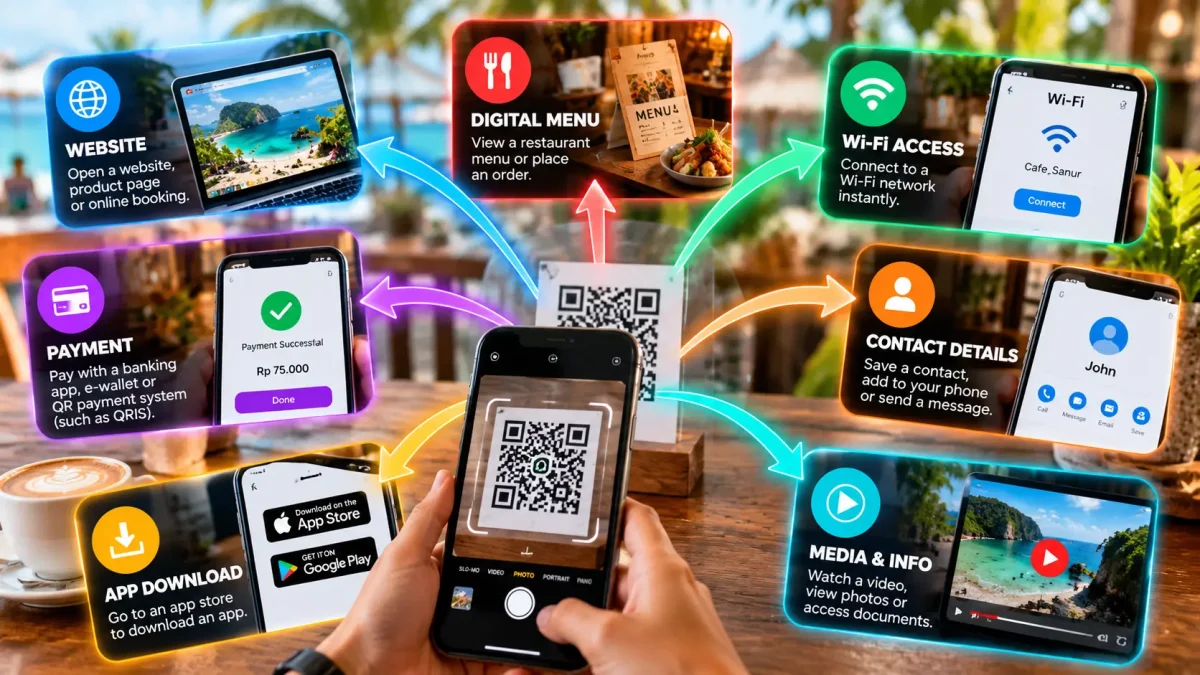
Depending on how it is created, a QR code might contain:
- A website address.
- Contact details.
- Product identification information.
- A digital ticket or booking reference.
- WiFi connection details.
- Payment instructions.
- Information used by an app to complete a transaction.
For a full list of what QR code types are available, see: QR code types
The important distinction is that a QR code is a way of encoding and accessing information, not a payment system in itself.
That distinction becomes particularly important when we start talking about international payments.
The code might identify a merchant or communicate payment details, but the banking networks, payment providers and financial institutions behind the transaction do the actual work of moving the money.
And that brings us to the beginning of the story.
1994: Born on a Japanese Factory Floor
QR codes weren’t invented for smartphones, restaurants or digital marketing.
They were developed for the automotive industry.
In 1994, engineers at DENSO WAVE, a Japanese company associated with the Toyota Group, introduced the QR Code to address a practical manufacturing problem.
Factories needed a better way to track components and manage increasingly complex production processes.
Traditional barcodes had limitations. As manufacturers handled more product variations and needed to record more information, a more capable system was required.
The development team, led by engineer Masahiro Hara, created a code that could store substantially more information and be read quickly.
It was also designed to remain readable when partially damaged or contaminated, a useful feature in demanding industrial environments.
The name reflected its purpose: Quick Response.
The technology was subsequently standardised and made available for widespread use, helping it spread beyond its original industrial applications.
You can explore the history directly through the official QR Code history published by DENSO WAVE.
At the time, nobody needed to imagine a customer scanning a QR code to pay for a coffee.
The immediate challenge was much simpler: how do we identify things faster and manage information more efficiently?
As it turned out, that simple idea had considerably greater potential.
The Early Days: An Interesting Technology Looking for Its Moment
QR codes gradually moved into other industries, including logistics, retail, advertising and product identification.
Mobile phones capable of scanning QR codes appeared in Japan in the early 2000s.
That opened up an entirely new possibility.
Instead of requiring a dedicated industrial scanner, a person could use a mobile phone to access information simply by pointing the camera at a printed code.
Imagine a magazine advertisement containing a QR code that takes you directly to a website.
Or a product package that links to instructions, product information or a promotional offer.
The possibilities were obvious.
However, widespread adoption depended on something else: people needed smartphones capable of scanning the codes easily, reliable mobile internet access and a compelling reason to use them.
For quite some time, the technology was useful without becoming essential.
Then smartphones improved, cameras became better and QR scanning became easier.
The stage was set.
What was missing was a reason for millions of people and businesses to change their habits at the same time.
COVID would provide that reason.
2020: COVID Changed Everything
When COVID arrived, businesses around the world were forced to reconsider how they interacted with customers.
Reducing physical contact became a priority.
Restaurants needed ways to provide menus without passing printed copies between customers. Businesses wanted contactless transactions. Governments and organisations needed digital systems for collecting information and managing access.
QR codes were a natural fit.
A restaurant could place a small printed code on a table. Customers scanned it with their phones and viewed the menu without touching a shared menu card.
Businesses could provide digital forms, booking details and other information without requiring customers to handle paper documents.
In some countries, QR codes also became part of systems used for health declarations, vaccination records and venue access.
Not every application was equally effective, and QR codes alone did not make an environment safe. However, they offered a convenient way to connect the physical world with digital information.
Research published after the pandemic has continued to examine the adoption of QR code menus and the factors influencing whether customers want to keep using them.
The important change wasn’t simply that more people learned how to scan a code.
COVID gave businesses and consumers a reason to adopt a technology they might otherwise have ignored.
Millions of people developed new habits almost simultaneously.
Once those habits were established, many applications continued to make sense after the immediate health concerns had diminished.
Digital menus remained convenient for some restaurants. Electronic tickets remained useful for events. Contactless payments continued to appeal to customers and merchants.
COVID accelerated adoption, but it did not create the underlying technology.
And nowhere is the longer term potential more interesting than in digital payments.
From Reading Information to Moving Money
There’s a big difference between scanning a QR code to open a website and scanning one to pay for a purchase.
Opening a website is relatively straightforward. The code directs your phone to an address.
A payment involves more moving parts.
The system needs to identify the merchant, determine the payment details, authenticate the customer, authorise the transaction and arrange the transfer of funds.
The exact process depends on the payment system being used.
In some systems, the merchant displays a QR code that the customer scans using a banking or payment app.
In others, the customer generates a code that the merchant scans.
Either way, the code acts as a bridge between the physical transaction and the digital payment infrastructure.
This has a major advantage for small businesses.
A merchant may not need a traditional card terminal to accept digital payments. Depending on the local system and its requirements, a printed QR code can be enough to get started.
That can make digital payments more accessible to market traders, independent retailers, restaurants and small service providers.
For businesses operating on tight margins, simplicity matters.
There may be no specialised terminal to purchase, maintain or connect to the internet. Customers can use compatible banking or payment applications they already have.
Of course, fees, settlement arrangements, merchant eligibility and technical requirements vary between providers and countries.
But the general principle is powerful.
A low cost printed code can connect a small business to a much larger digital payment ecosystem.
Indonesia: QRIS and the Digital Payment Revolution
Indonesia provides an excellent example of how QR codes have moved beyond convenience and become part of a country’s financial infrastructure.
The system is called QRIS, pronounced roughly as kris.
QRIS stands for Quick Response Code Indonesian Standard.
Introduced by Bank Indonesia and implemented with the Indonesian payment industry, QRIS provides a common QR payment standard across participating payment providers.
Before a common standard, businesses and consumers could face a fragmented landscape of different payment applications and systems.
Standardisation helps make the process more consistent.
A participating merchant can display a QRIS code and accept payments through compatible applications rather than needing a separate QR code for every participating provider.
This is particularly useful for Indonesia’s enormous small business sector.
Think about a small coffee shop in Sanur.
The owner wants customers to pay conveniently but doesn’t necessarily want the cost or complexity of installing a traditional payment terminal.
A QRIS code provides a practical alternative.
The customer scans the code, confirms the payment in a compatible application and completes the transaction digitally.
For the merchant, this can simplify payment collection and reduce dependence on cash.
For the customer, it offers another way to pay.
For the broader economy, it helps bring more transactions into the digital financial system.
Bank Indonesia has continued to expand the QRIS ecosystem, including its cross border payment connections.
And this is where the story becomes genuinely international.
The Next Step: QR Codes That Work Across Borders
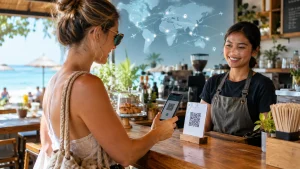
Imagine you’re visiting Bali from Singapore.
You stop at a local restaurant, order lunch and reach for your wallet.
Instead of searching for cash or wondering whether your credit card will be accepted, you scan the merchant’s QR code using a compatible payment application.
The payment is processed through a system that connects the participating payment networks in the two countries.
The transaction can be completed in Indonesian rupiah for the merchant, while the customer’s payment is handled through the arrangements supported by their home payment provider.
The precise exchange rate, fees and payment experience depend on the participating institutions and the specific arrangement.
The important point is that the customer doesn’t necessarily need a local Indonesian bank account or a separate Indonesian payment application to make the purchase.
This is the promise of cross border QR payments.
Rather than treating every country as a completely separate payment environment, participating countries connect their domestic systems so that people can use compatible services when travelling abroad.
Indonesia has been developing these connections with several international partners.
The idea is straightforward, even if the technology and financial arrangements behind it are not.
Make it easier for people to pay when travelling, help businesses accept payments from international visitors and reduce some of the friction associated with cross border transactions.
For tourism dependent economies, that could be particularly valuable.
Indonesia’s QRIS Goes International
Indonesia’s cross border QR payment initiative has expanded beyond its domestic market.
Connections have been established with countries including Thailand, Malaysia, Singapore and Japan, with South Korea added in 2026.
The arrangements allow participating users to pay at supported merchants in partner countries through compatible domestic payment applications.
For example, Indonesian users can use supported QRIS applications to pay at participating merchants in Japan, while the Indonesia South Korea connection allows Indonesian users to make payments in South Korea through supported domestic applications.
These arrangements are not universal acceptance of every QR code. They depend on participating payment providers, merchants and the specific cross border connection.
Nevertheless, the direction is clear.
National payment systems that once operated largely within their own borders are increasingly being connected.
Bank Indonesia reported that the Indonesia South Korea connection officially launched on 1 April 2026.
Its February 2026 figures also showed that QRIS cross border payments were already being used at meaningful scale across existing partner markets.
For the period covered by those figures, Indonesia Malaysia connectivity had recorded 10.66 million transactions worth Rp2.75 trillion, while the Thailand connection had recorded 1.64 million transactions worth Rp656.27 billion.
Those figures demonstrate that this is no longer simply an experiment involving a handful of travellers.
The implications extend beyond the technology itself.
Cross border QR payments can help simplify the payment experience for tourists, give local merchants access to more customers and support the broader shift towards digital financial services.
And for a place like Bali, that’s particularly relevant.
What Does This Mean for Bali’s Tourism Businesses?
Let’s bring this back to everyday business.
Bali welcomes visitors from many countries, each with their own banking arrangements, currencies and payment preferences.
A tourist arriving from Australia might be comfortable using a credit card.
A visitor from Singapore may regularly use a mobile payment application.
Someone from Indonesia may already use QRIS for everyday purchases.
The challenge for a small business is accommodating these different expectations without making payment acceptance unnecessarily complicated.
Cross border QR connections offer one way to address that challenge.
Imagine a small warung, independent coffee shop or local tour operator.
With an appropriate participating payment arrangement, the business may be able to accept digital payments from eligible international visitors through its existing QR payment infrastructure.
The business doesn’t necessarily need to understand the technical details of the customer’s home banking system.
It needs to display the appropriate payment code, follow the rules of its payment provider and receive confirmation that the transaction has succeeded.
That simplicity is important.
Digital payment technology becomes more valuable when it removes friction rather than adding another layer of complexity.
There are practical considerations, of course.
Not every tourist’s banking app will work with every Indonesian QR code. Merchants must understand their provider’s settlement process, applicable fees and refund procedures. Customers need to know which payment methods are supported.
Businesses should also retain sensible alternatives for customers who prefer cash or cards.
But the potential is clear.
For Bali’s smaller businesses, the opportunity isn’t simply to replace cash.
It’s to make it easier for international customers to spend money locally.
The Bigger Picture: A More Connected Asian Payment Network
The international implications extend beyond QR codes themselves.
Across Asia, central banks and payment operators are working to connect national payment systems.
QR payments are one part of that wider development.
Another part involves linking instant payment systems so that people can transfer money across borders more quickly and efficiently.
The Bank for International Settlements has supported this work through initiatives such as Project Nexus.
Project Nexus was designed to connect participating countries’ domestic instant payment systems through a common framework, rather than requiring every country to build a separate connection with every other country.
In 2025, the central banks of India, Indonesia, Malaysia, the Philippines, Singapore and Thailand incorporated Nexus Global Payments to take the initiative towards live implementation.
The objective is to improve the speed, cost, transparency and accessibility of international payments.
Why does this matter to QR codes?
Because the customer experience is only one part of the equation.
A QR code can make it easy to initiate a transaction, but the payment still needs a reliable system behind it.
Connecting national payment networks helps create the infrastructure needed to support a more seamless international experience.
In the future, the experience of paying for lunch overseas could become almost as straightforward as paying at home.
That doesn’t mean every country’s payment systems will become interchangeable overnight. Regulatory requirements, foreign exchange arrangements, security standards and commercial agreements still need to be addressed.
But the direction of travel is towards greater connectivity.
And that’s a much bigger development than simply putting a QR code on a restaurant table.
The Benefits Go Beyond Convenience
International QR payments could deliver several important benefits.
1. Less Dependence on Cash
Travellers may need to carry less local currency for everyday purchases when compatible digital payment options are widely available.
Cash will remain important, but digital alternatives can make some transactions easier.
2. Greater Access for Small Businesses
A small merchant may be able to accept digital payments without investing in traditional card acceptance equipment.
This can lower one of the barriers to participating in the digital economy.
3. More Convenient Tourism
Visitors can potentially use familiar payment applications in participating overseas markets.
That reduces some of the uncertainty associated with paying in an unfamiliar country.
4. Faster Transactions
Participating cross border QR payments can be processed in real time once successfully completed, depending on the arrangement.
The actual experience depends on the payment providers, banking infrastructure and transaction requirements involved.
5. Support for Local Economies
Making it easier for international visitors to pay local businesses could help more tourism spending reach small merchants.
For economies with large numbers of small retailers and service providers, this is an important consideration.
6. Potentially More Efficient Currency Conversion
Cross border payment arrangements can support transactions using local currencies and reduce some of the friction associated with traditional international payment methods.
However, customers should still check the exchange rates and fees applied by their payment providers.
The benefits are real, but they depend on good implementation, reliable infrastructure and widespread acceptance.
The Challenges: QR Codes Aren’t a Magic Wand
For all their advantages, QR codes introduce some challenges of their own.
Different Standards and Payment Systems
A QR code that works with one banking application may not work with another.
Even where countries have introduced common domestic standards, international compatibility requires additional arrangements.
A merchant cannot assume that displaying a QRIS code means every international visitor can pay with it.
Security and Fraud
QR codes are easy to print, which is both an advantage and a potential weakness.
Someone could place a fraudulent code over a legitimate merchant’s code, directing payments to the wrong account.
Malicious QR codes can also direct users to fraudulent websites designed to steal personal information or payment credentials.
Customers should check the merchant details displayed in their payment application before confirming a transaction.
Merchants should regularly inspect displayed codes and use appropriate security practices.
Privacy
Digital transactions can generate records that reveal spending patterns, locations and purchasing behaviour.
The collection, use and protection of this information depend on the payment providers, applicable laws and the systems involved.
Consumers should understand the permissions and privacy policies associated with their payment applications.
Digital Exclusion
Not everyone has a modern smartphone, a reliable internet connection or access to a compatible banking application.
Some people also prefer not to use digital payment systems.
A business that removes every alternative risks excluding potential customers.
Fees and Foreign Exchange
Cross border transactions may involve currency conversion, payment provider fees or other charges.
The actual cost depends on the specific arrangement.
A convenient payment experience is not automatically the cheapest one.
These challenges don’t undermine the potential of QR payments. They simply remind us that successful technology depends on more than a clever idea.
It also requires trust, security, accessibility and sensible implementation.
What Happens Next?
The next stage of QR adoption is likely to be less about teaching people how to scan a code and more about connecting the systems behind it.
Several developments are worth watching.
More Countries Connecting Their Payment Networks
As more countries establish cross border arrangements, travellers may find it easier to use their existing payment applications overseas.
Indonesia’s expanding QRIS connections provide a useful example of this direction.
The pace of expansion will depend on agreements between central banks, payment operators and participating financial institutions.
Better Integration With Travel and Tourism
QR codes are already used for tickets, bookings, restaurant menus and payments.
More integrated systems could help businesses connect these activities into a smoother customer experience.
For example, a customer might move from viewing a tour operator’s information to making a booking and completing a payment with fewer separate steps.
The challenge will be to make the experience genuinely simpler rather than adding unnecessary technology.
Greater Opportunities for Micro Businesses
As digital payment infrastructure becomes more accessible, smaller businesses may find it easier to serve international customers.
This could be particularly valuable in tourism destinations, where many businesses operate independently rather than as part of large hotel or retail chains.
More Competition in Digital Payments
As payment networks become more interconnected, banks, payment providers and financial technology companies will have new opportunities to compete.
That could lead to better services and greater convenience.
Whether it also leads to lower costs will depend on competition, pricing and the regulatory environment.
Continued Focus on Security
As QR payments become more common, payment providers and merchants will need to keep improving fraud prevention, transaction verification and consumer education.
The easier a technology becomes to use, the more important it is to make it safe.
A Small Square With a Big Future
It’s remarkable to think that QR codes were developed to solve a manufacturing problem more than three decades ago.
For years, they remained a useful but relatively specialised technology.
Then smartphones made them easier to use, and COVID accelerated their adoption across everyday life.
Today, they help connect printed information with digital services, simplify transactions and support the growing integration of payment systems across national borders.
Indonesia’s QRIS system demonstrates how a common standard can make digital payments more accessible to small businesses.
Its international connections show how that domestic infrastructure can become part of a wider network.
And initiatives such as Project Nexus illustrate the broader ambition to make international payments faster and more efficient.
Of course, QR codes won’t eliminate cash, cards or traditional banking systems.
Nor will every country adopt the same technology or approach.
But they have become an important part of how people and businesses interact with the digital economy.
For a small business in Sanur, that might mean accepting a payment from an eligible overseas visitor.
For a traveller, it might mean paying for lunch without worrying about finding an ATM.
And for the international financial system, it represents one small piece of a much larger effort to make money move more easily across borders.
Sometimes, the biggest technological changes don’t arrive with a bang. They arrive as a little black and white square on the table in front of you.
Your Turn
Have you noticed how quickly QR codes have become part of everyday life?
Are you using them for payments, restaurant menus, travel bookings or something else entirely?
And if you’re running a business, have QR payments made life easier, or have they simply introduced another system you need to manage?
I’d be interested to hear your experiences.
Because the technology is only part of the story. What really matters is how we use it to make everyday life and business a little simpler.