It’s Not Immigration, It’s “Labor Mobility.”
You know how the word immigration sparks a reaction?
For some, it’s hope. For others, it’s politics.
But in reality, the world’s not debating immigration anymore — it’s quietly living through something bigger: labor mobility.
The game’s changed.
People no longer just move countries — they move skills, income, and influence.
Sometimes without even leaving their couch.
The new migration story
Back in the day, you’d pack a suitcase, board a plane, and start fresh somewhere new.
That was migration — movement across borders.
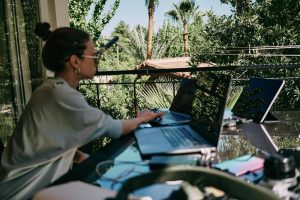
Now? You can work for a company in Sydney, live in Bali, get paid in USD, and never set foot in an office.
That’s labor mobility.
It’s not a visa stamp anymore. It’s a broadband connection.
The work moves, even if you don’t
Let’s be honest — remote work broke the geography rule.
A coder in Ubud can be part of a San Francisco startup.
A copywriter in Melbourne can work for a London agency.
A finance analyst in Lagos can manage books for a firm in Berlin.
They didn’t “migrate.”
Their work did.
And that subtle shift is shaking up governments, HR policies, and even economies. Because once you separate work from place, everything else — taxes, regulation, education, even culture — starts playing catch-up.
Governments are still playing an old game
Immigration policy still assumes that people move physically to contribute economically.
But talent isn’t waiting for visas anymore — it’s logging in.
Countries like Singapore, Portugal, and the UAE have caught on fast, creating “digital nomad visas” and flexible residency schemes.
Others are still debating border quotas while their best opportunities are crossing the digital border daily.
The new reality? The borderless workforce has arrived, and no immigration form can keep up.
From migration to mobility: a quiet revolution
Labor mobility isn’t just about moving to another country for a job.
It’s about being able to move between roles, industries, and even identities — quickly and flexibly.
Think of it like this:
- Geographic mobility – living or working across borders.
- Occupational mobility – shifting careers or skills.
- Functional mobility – working across teams, industries, even time zones.
Combine them and you’ve got the new DNA of work: adaptable, digital, mobile.
Why this matters more than ever
In an ageing world where economies are struggling to find skilled talent, mobility is gold.
It means productivity, diversity, and resilience.
For workers, it means freedom — to work where you thrive, not where you’re trapped.
For employers, it means global access to talent.
For countries, it means fresh opportunity — if they’re smart enough to harness it.
But here’s the catch:
Most systems — tax, education, labour law — were built for a world where work stayed still.
Now, it’s on the move.
The digital nomad isn’t a fringe story anymore
What used to be a niche lifestyle is fast becoming a mainstream labour category.
Millions of people are semi-mobile workers — blending remote jobs with travel or relocation.
Bali’s seen it firsthand.
The cafes in Canggu and Uluwatu are full of mobile workers: software developers, designers, teachers, coaches, marketers — all contributing to the global economy from their laptops.
They’re not immigrants. They’re participants in the new global workforce.
And that raises new questions:
Who benefits? Who gets taxed? Who gets protected?
When work becomes weightless, you start seeing the real divide — not between rich and poor, but between the mobile and the immobile.
The mobility divide
We talk about income inequality, but we rarely talk about mobility inequality.
The ability to move — physically, digitally, or socially — is now one of the biggest advantages you can have.
If you’ve got the right passport, skills, and internet connection, the world’s open.
If you don’t, you’re stuck competing in a smaller, local market that’s shrinking.
That’s the uncomfortable truth of global labour mobility — it expands opportunity, but it also exposes who’s been left behind.
AI, automation, and the next wave
AI isn’t replacing people as much as it’s relocating the work.
Tasks move to where they can be done fastest and cheapest — whether by humans or machines.
And that means mobility isn’t optional anymore. It’s survival.
Learning new skills, switching roles, adapting to tech — that’s occupational mobility.
You don’t need to move cities — just mindsets.
As one friend put it:
“The best people aren’t job hunting anymore — they’re opportunity surfing.”
What companies are doing about it
Smart companies aren’t fighting mobility — they’re designing for it.
Instead of relocating staff, they’re building distributed teams.
Instead of measuring time in office, they’re measuring outcomes across time zones.
Instead of sponsorships, they’re offering flexibility, co-working stipends, and location choice.
And the best leaders have stopped asking “Where’s your office?”
They ask, “Where are you happiest working?”
Because the real ROI isn’t rent savings — it’s retaining talent that could be anywhere.
How governments could win (if they stop thinking like border guards)
Forward-thinking governments will focus less on who enters and more on who contributes.
Imagine tax systems that flex for remote workers.
Education visas that prioritise skill circulation, not just immigration numbers.
Workforce policies that attract projects, not just people.
Countries that embrace mobility will attract not just talent, but capital, creativity, and cultural energy.
Those that don’t will watch it flow elsewhere — silently, digitally, permanently.
The individual’s playbook
So, what can you do in a world that’s moving this fast?
Here’s the short list:
- Be mobile in skills. Keep learning, pivoting, stacking new capabilities.
- Be mobile in mindset. Think like a global citizen even if you never leave your town.
- Be mobile in network. Connect across borders — digital relationships open real doors.
- Be mobile in opportunity. If your country or company limits you, look elsewhere.
Mobility isn’t just physical anymore — it’s intellectual and emotional.
It’s the courage to move when the world won’t move for you.
So where does this leave immigration?
Immigration isn’t dead — it’s evolving.
The 20th century was about people moving to find work.
The 21st century is about work moving to find people.
And that’s why we need a new word.
Labor mobility isn’t a political hot potato.
It’s a human story — about talent, technology, and the timeless desire to improve your lot.
The kind of story that crosses every border and still makes sense in any café, co-working space, or corner of the internet.
And So….
It’s not immigration.
It’s mobility.
And whether you’re running a business, building a career, or shaping policy, that single shift changes everything.
Because the future of work isn’t about where you live —
It’s about where your value can move.