
Why Running a Members Only Affiliate Program Stunts Growth
Quick Read TL;DR
There is a seductive logic behind making a community’s affiliate programme members only:
“Our members know the product. They understand the value. They can recommend it authentically.”
And that logic is not wrong.
It is simply incomplete.
Your members may be your best advocates.
But they are not necessarily your best marketers.
The moment an affiliate programme is restricted exclusively to existing members, the business owner has quietly made one of the most important acquisition channels dependent upon the size, enthusiasm and networks of the people who have already bought.
That creates a growth ceiling.
A much more powerful model is:
Members + external affiliates + creators + partners + influencers + complementary businesses + existing customers.
The distinction matters enormously.
Affiliate marketing is not fundamentally about finding people who know your product.
It is about finding people who already have access to the people you want as customers.
And there is a very big difference.
The global affiliate industry isn't shrinking into a little referral programme for existing customers. The U.S. affiliate marketing industry reached $13.62 billion in investment in 2024, up 49.8% from 2021, and generated an estimated $113 billion in ecommerce sales. The Performance Marketing Association says affiliate generated an estimated 9.4% of U.S. ecommerce sales.
So if you're building a recurring revenue business and your affiliate strategy is:
“Our existing members can refer people if they want.”
You're not really operating an affiliate acquisition strategy.
You're operating a customer referral programme.
Those are two very different things.

Big Fish Small Pond or The Ocean
The Deep Dive
The Affiliate Mistake I See Again and Again
I've spent years watching businesses approach affiliate marketing with a strangely narrow definition.
They think:
Affiliate = existing customer recommending us.
That's one form of affiliate marketing.
It isn't the whole game.
A serious affiliate programme is an external distribution network.
You're effectively saying:
“I have a product people want. You already have access to people who might want it. If you introduce them and they become customers, I'll share the economics with you.”
That's a remarkably powerful proposition.
And importantly, you don't pay for the introduction.
You pay for the result.
That distinction becomes particularly interesting when the product is a subscription.
Because now you're not buying advertising.
You're buying customer acquisition with a variable cost tied to revenue.
That's exactly why affiliate marketing can be so attractive for businesses chasing MRR.
The “They Need To Know The Product” Argument
This is probably the most common reason I hear for restricting affiliates to members.
And on the surface, it sounds sensible.
After all, how can somebody recommend something they don't understand?
But there's a problem.
You don't actually need every affiliate to know everything about your product.
You need them to understand:
- Who it is for
- What problem it solves
- What outcome it produces
- Why their audience should care
- How to make the referral
That's marketing.
And the best external affiliates are often better at that than your average customer.
A creator with 50,000 followers in your target market may understand their audience's problems far better than a random existing member.
A newsletter owner may have spent ten years building trust with exactly the people you're trying to reach.
A consultant may speak to your ideal customer every day.
A YouTuber may have spent years creating content around the problem your product solves.
A complementary business may already have thousands of customers who need what you sell.
None of those people need to become members first.
They need a reason to recommend you.
Your Members Are Not Your Market
This is the subtle trap.
Suppose a community has:
500 members.
If only 10% actively refer people, that's 50 potential referrers.
Great.
But each of those 50 people has a finite personal network.
And more importantly, there is probably enormous overlap between their networks.
Now imagine adding:
50 external affiliates.
Those affiliates might collectively have audiences of:
- 5,000
- 10,000
- 50,000
- 100,000+
- or millions
And they aren't necessarily talking to the same people.
Suddenly your acquisition network has expanded beyond the community itself.
That's the real power of affiliate marketing.
You aren't simply motivating customers to sell.
You're borrowing distribution.
 Skool Is Actually a Brilliant Example
The irony is that the platform many community owners are using provides a very good example of why the thinking needs to be broader.
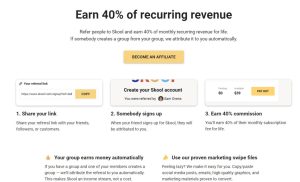
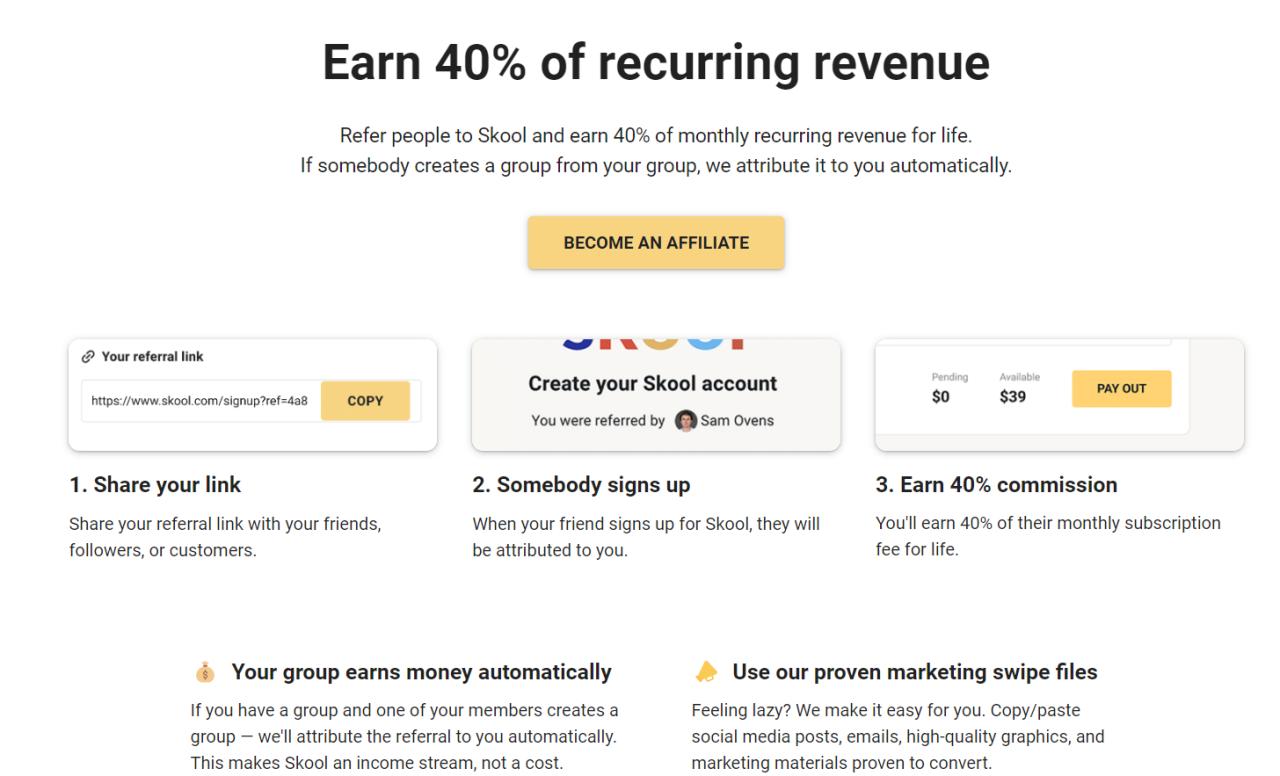
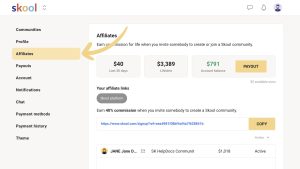
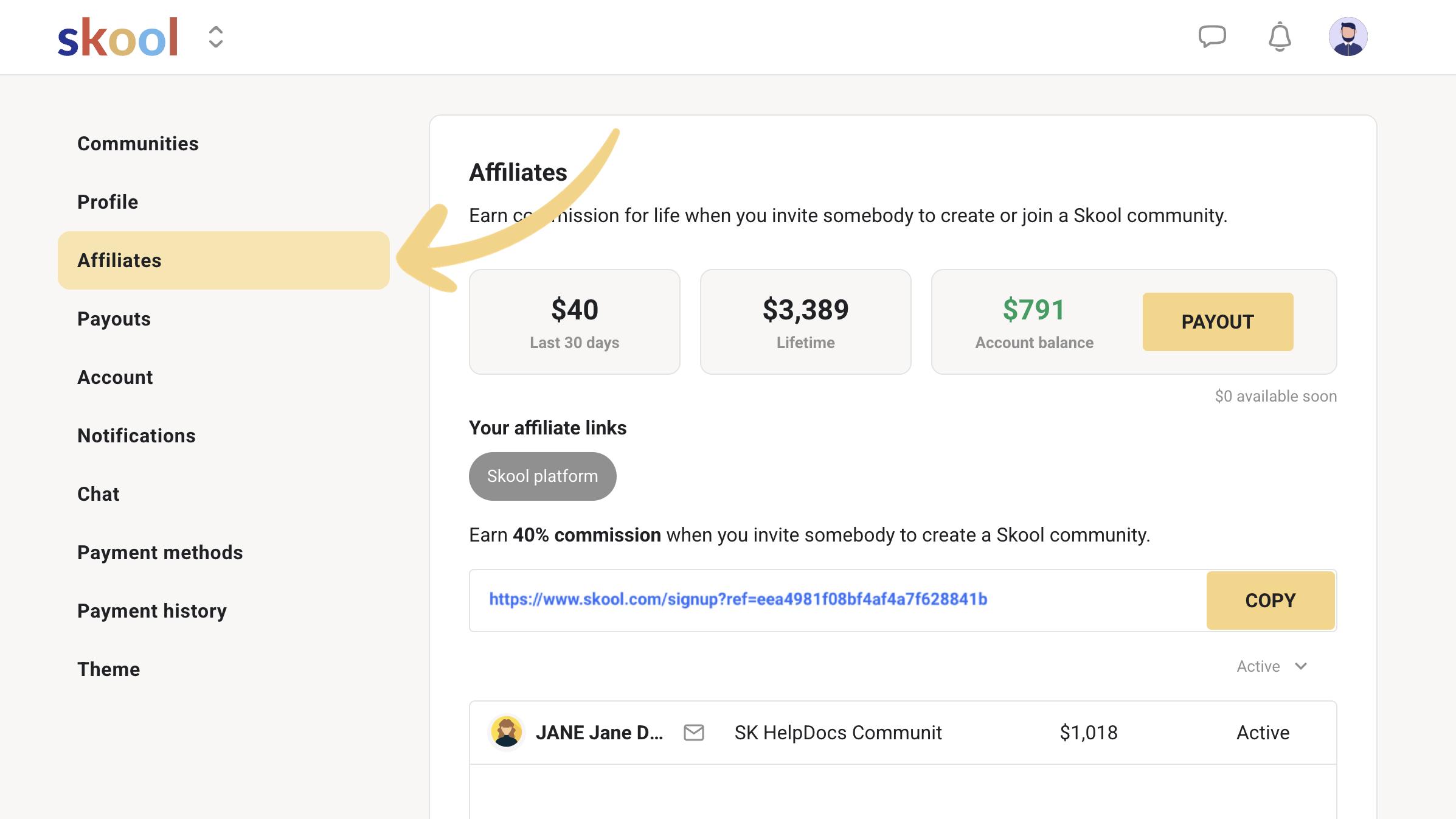
Its own help documentation gives the example that a Pro referral produces $39/month in affiliate commission, while a Hobby referral produces $3.60/month, based on the applicable subscription pricing.
That's an important signal.
Skool isn't saying:
“You need to be a member of somebody else's community before you're allowed to refer Skool.”
It has built a much broader distribution model.
And then it goes one step further.
 Growth Boost Is Basically Affiliate Marketing At Scale
Skool's Growth Boost programme is particularly interesting.
Skool promotes eligible communities through Discovery and off platform advertising.
If Skool brings the customer, Skool takes a 30% commission on the recurring subscription revenue.
If the creator brings the customer themselves, that Growth Boost commission isn't charged.
Think about what that means.
Skool is effectively saying:
“We'll put our money behind acquiring customers for you. If we succeed, we'll share in the recurring revenue.”
That's performance marketing.
And the model is remarkably similar to a sophisticated affiliate arrangement.
No customer acquisition?
No commission.
Customer acquisition?
Revenue share.
Recurring customer?
Recurring share.
That's a very different mindset from:
“Let's only let our existing customers promote us.”
 And Skool Understands Something Else
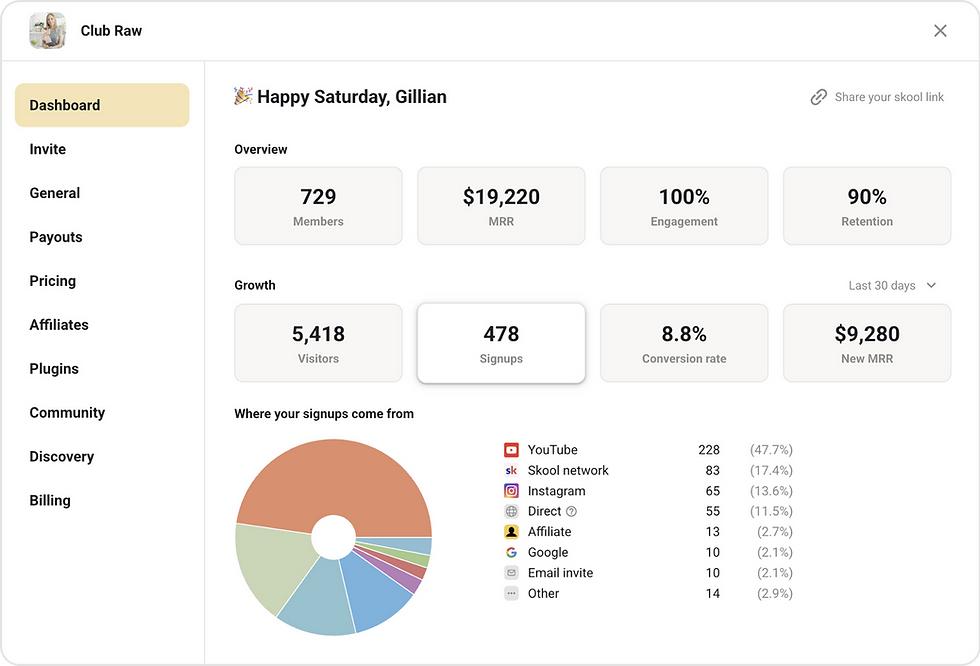
Skool's current Discovery system explicitly considers member growth, engagement and retention when ranking communities.
In other words:
Growth creates signals.
More people discovering the community can lead to more members.
More members can lead to more activity.
More activity can improve the community's visibility.
Better retention improves the economics.
And successful acquisition creates the possibility of more acquisition.
That's a flywheel.
Affiliate marketing can be one of the mechanisms that starts turning it.
The Numbers Make The Point
Let's use a hypothetical community charging:
$49/month
Imagine three different acquisition scenarios.
| Acquisition source | New members/month | Gross MRR added | 30% commission | Net MRR before fees |
|---|---|---|---|---|
| Existing members only | 20 | $980 | $294 | $686 |
| 10 external affiliates × 5 sales | 50 | $2,450 | $735 | $1,715 |
| 20 external affiliates × 10 sales | 200 | $9,800 | $2,940 | $6,860 |
| 50 external affiliates × 10 sales | 500 | $24,500 | $7,350 | $17,150 |
These aren't forecasts.
They're illustrations of the economics.
And that's the point.
Paying 30% of revenue to acquire a customer isn't automatically expensive.
If the customer stays for 12 months:
$49 × 12 = $588 revenue
At 30% commission:
$176.40 acquisition cost
Leaving:
$411.60 gross revenue before other costs.
If the customer stays for 24 months:
$1,176 revenue
30% commission:
$352.80
Remaining:
$823.20
The economics become increasingly attractive as retention improves.
And that is why MRR businesses and affiliate marketing can fit together exceptionally well.
Now Look At 40%
Skool itself demonstrates an even more aggressive model.
At 40% commission on a hypothetical $49/month subscription:
Affiliate earns $19.60/month.
The business retains:
$29.40/month before other fees and costs.
Over 12 months:
| Affiliate | Business | |
|---|---|---|
| Monthly | $19.60 | $29.40 |
| 12 months | $235.20 | $352.80 |
| 24 months | $470.40 | $705.60 |
| 36 months | $705.60 | $1,058.40 |
And here's the important bit:
Both sides have an incentive for the customer to remain.
That's a fundamentally different relationship from buying a $500 Facebook ad that produces a click and hoping it converts.
The External Affiliate Changes The Equation
Let's imagine an affiliate has:
25,000 relevant followers.
They don't need all 25,000 to buy.
They might generate:
- 1,000 landing page visits
- 100 trials or enquiries
- 20 customers
At $49/month:
20 × $49 = $980 new MRR
That's $11,760 annualised recurring revenue from one affiliate's initial batch of customers.
Now imagine 10 affiliates producing something similar.
That's:
$117,600 annualised recurring revenue.
Again, these are scenario calculations, not claims about expected performance.
But they demonstrate why the size of the affiliate pool matters.
The Real Problem With Members Only
There are several hidden costs.
1. You limit your distribution
Your affiliates come from the same ecosystem you're trying to grow.
That's inherently limiting.
2. You limit recruitment
The best potential affiliate may never discover your community because they're not a member.
You've excluded them before they even enter the conversation.
3. You confuse advocacy with marketing
A happy customer saying:
“I love this community.”
is valuable.
A professional affiliate saying:
“I've helped 20,000 people solve this particular problem. Here's why this community is worth joining.”
can be considerably more powerful.
4. You create an artificial ceiling
If your community has 1,000 members, your affiliate recruitment pool is effectively constrained by those 1,000 people.
An open affiliate programme could theoretically recruit:
10,000 affiliates.
Or 100.
Or 25.
There is no reason to impose an artificial ceiling.
5. You miss complementary audiences
Some of your best affiliates won't want to become members.
They don't need your product.
Their audience does.
That's a completely legitimate affiliate relationship.
“But Won't External Affiliates Be Low Quality?”
Some will.
That's normal.
And it's not an argument against external affiliates.
It's an argument for affiliate management.
You don't have to approve everyone.
You can:
- Require an application
- Review their audience
- Check their content
- Define promotional rules
- Prohibit misleading claims
- Set commission structures
- Monitor conversions
- Monitor refunds
- Remove poor performers
- Reward high performers
That's how a proper affiliate programme works.
You don't open the front door and hand everyone the keys.
You build a partner ecosystem.
The Better Model: Two Affiliate Layers
This is where I think the smartest community businesses should be heading.
Layer 1 — Member Advocates
These are your customers.
They know the product.
They understand the community.
They can naturally recommend it.
Give them an easy referral mechanism.
Layer 2 — External Growth Partners
These are:
- Creators
- Influencers
- Newsletter owners
- Bloggers
- YouTubers
- Podcasters
- Coaches
- Consultants
- Agencies
- Complementary businesses
- Industry educators
- Existing affiliate marketers
They don't necessarily need to become customers.
They need to be able to sell the outcome.
That gives you the best of both worlds.
This Isn't Just Theory
The broader affiliate industry is enormous because businesses have discovered something very simple:
Other people's audiences can be incredibly valuable.
The PMA's 2025 industry study found U.S. affiliate marketing investment reached $13.62 billion in 2024, producing an estimated $113 billion in ecommerce sales.
And the industry continues to evolve beyond traditional coupon sites.
Research from impact.com found that 74% of brands generate 11–30% of their total revenue from affiliate marketing, while 59% of brands surveyed planned to allocate at least 25% of their affiliate budgets to creator partnerships.
That's important.
The modern affiliate isn't necessarily the person posting:
“CLICK MY LINK FOR 10% OFF.”
Increasingly, it's the creator who has trust, attention and relevance.
Even Mature Affiliate Programmes Have A Lesson
The PMA's 2024 brand survey found that the majority of affiliate programmes had 100 or fewer sale active publishers, with almost half reporting 50 or fewer.
But mature programmes had significantly more affiliates and more active affiliates than newer programmes.
There's a very obvious lesson here:
Affiliate programmes compound.
You don't necessarily launch with 500 brilliant partners.
You start with a handful.
You discover who works.
You support them.
You recruit more.
You improve the offer.
You improve the landing page.
You improve attribution.
You improve onboarding.
And the programme gets better.
The Biggest Mistake Is Actually Having No Affiliate Programme
And this is the other side of the argument.
Restricting affiliates to members isn't ideal.
But having no affiliate programme at all may be considerably worse.
Because then every potential customer acquisition channel has to be funded by:
- Your own advertising
- Your own content
- Your own social reach
- Your own email list
- Your own sales activity
- Your own time
You're building the entire distribution machine yourself.
An affiliate programme lets other people build pieces of it for you.
And you only pay when it produces the result.
That's a powerful proposition.
The MRR Flywheel
Here's the model I'd want to see:
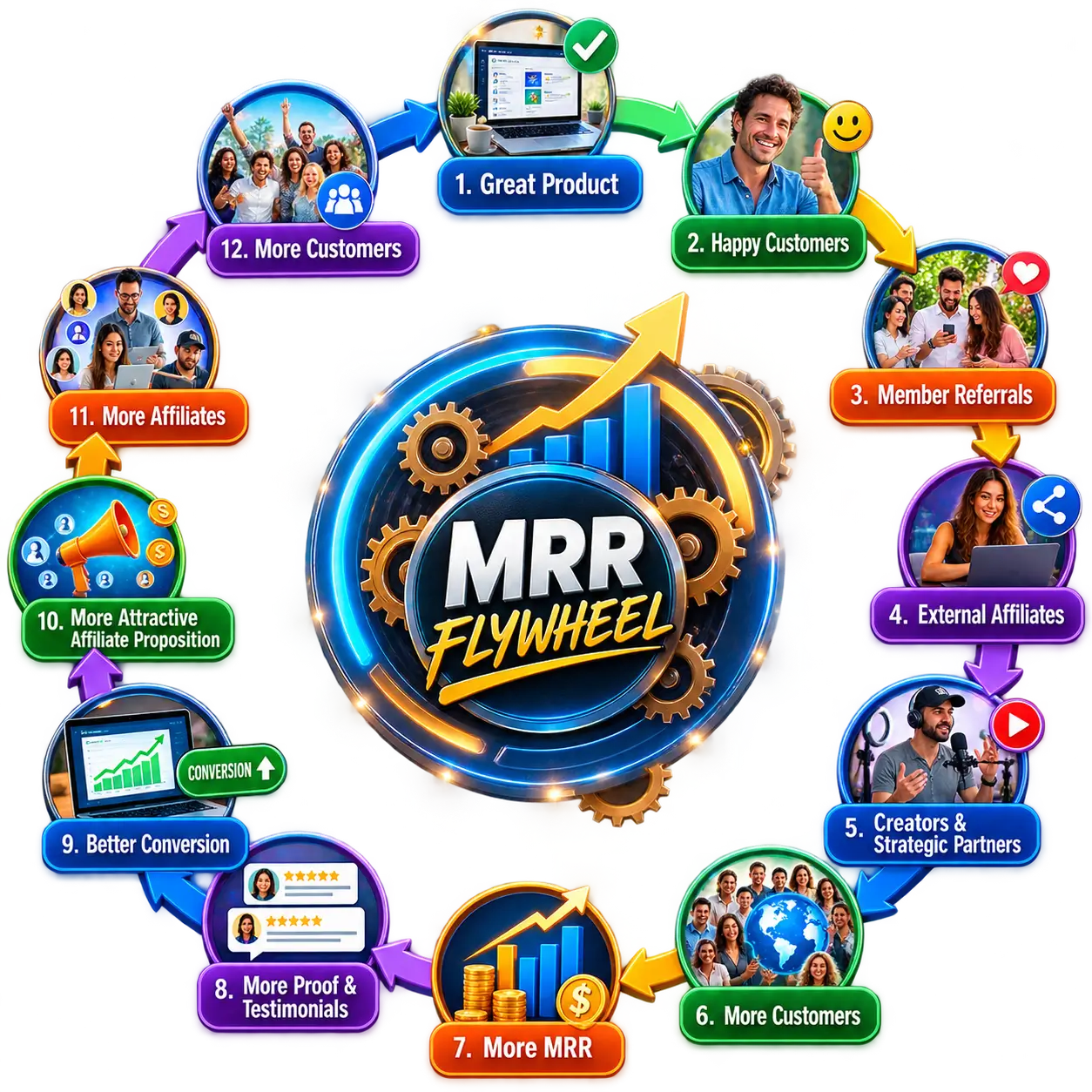 Great product
↓
Happy customers
↓
Member referrals
↓
External affiliates
↓
Creators & strategic partners
↓
More customers
↓
More MRR
↓
More proof & testimonials
↓
Better conversion
↓
More attractive affiliate proposition
↓
More affiliates
↓
More customers
And around it goes.
That's a flywheel.
A members-only affiliate programme only activates one small section of that flywheel.
An open, managed programme can activate the entire ecosystem.
And Here's The Counterintuitive Part
You don't even need thousands of affiliates.
You need the right ones.
Ten excellent affiliates can be worth more than 1,000 inactive members.
Imagine finding:
- One YouTuber with 100,000 relevant subscribers
- One newsletter with 40,000 subscribers
- One creator with 75,000 followers
- One consultant with 2,000 clients
- One podcast with 50,000 monthly listeners
They don't need to sell to everyone.
They need to find the small percentage of people for whom your offer is a perfect fit.
That's what makes affiliate marketing so attractive.
The Affiliate Doesn't Have To Know Everything
This is worth repeating.
The affiliate's job isn't to become your support department.
It's not to fulfil the product.
It's not to answer every technical question.
It's not to understand every feature.
Their job is to say:
“I know these people. I understand their problem. I believe this is a good solution. Here's where you can learn more.”
Then your:
landing page → onboarding → product → community → retention
does the rest.
If your conversion process requires every affiliate to become a product expert before they can recommend you, that may actually indicate a problem with the marketing system.
The Strategic Question Isn't “Who Knows Our Product?”
The better question is:
“Who already has the attention and trust of the people we want?”
That completely changes affiliate recruitment.
Instead of looking inward, you look outward.
You start mapping the ecosystem around your customer.
Who talks to them?
Who teaches them?
Who advises them?
Who creates content for them?
Who emails them?
Who sells complementary products?
Who already has their trust?
Those people become potential partners.
The Economics Of Giving Away 30% Or 40%
This is where business owners sometimes get emotionally stuck.
They see:
“I'm giving away 30%!”
I see:
“I'm buying a customer without paying upfront.”
Those are very different perspectives.
If someone brings you a customer who pays $49 every month for two years, you've generated:
$1,176 in revenue.
Would you happily pay $352.80 to acquire that customer?
If the answer is yes, then why wouldn't you build a system capable of finding hundreds of people who can do exactly that?
That's the question worth asking.
What A $10,000 MRR Affiliate Engine Could Look Like
Let's reverse engineer it.
At $49/month, you need:
204 members ≈ $10,000 MRR
Now suppose an affiliate programme generates those members.
Scenario A
20 affiliates × 10 customers
= 200 members
≈ $9,800 MRR
Scenario B
40 affiliates × 5 customers
= 200 members
≈ $9,800 MRR
Scenario C
100 affiliates × 2 customers
= 200 members
≈ $9,800 MRR
Notice something interesting?
You don't need an affiliate army.
You need a distribution network.
The Smartest Programme May Be 90% Dormant
This is another misconception.
Not every affiliate needs to be producing every month.
Affiliate programmes are portfolios.
You might have:
500 registered affiliates
of which:
- 400 produce nothing
- 50 produce occasionally
- 30 produce consistently
- 15 produce strongly
- 5 produce exceptionally
Those five may pay for the entire programme.
And that's okay.
The cost of having a dormant affiliate sitting in your database is usually tiny.
The upside of discovering one exceptional partner can be enormous.
So What's The Answer?
Don't choose between:
Members
and
External affiliates.
Use both.
Your members are your advocates.
Your external affiliates are your distribution partners.
Your creators are your attention partners.
Your strategic partners are your ecosystem partners.
And your affiliate system becomes the infrastructure connecting them all to your revenue model.
That is a much bigger opportunity than simply giving existing members a referral link.
The Bottom Line
There is nothing wrong with a members-only affiliate programme.
It can work.
It can produce referrals.
It can reward loyal customers.
It can create another reason for members to spread the word.
But making it members only is where the strategy becomes unnecessarily restrictive.
Because the people most capable of growing your business may not be inside your community.
They may be outside it, talking to your next 10,000 customers.
And that's the fundamental distinction.
A customer referral programme asks your customers to bring you customers.
An affiliate programme builds a network of people who can bring you customers.
One is a feature.
The other is an acquisition channel.
And if you're serious about growing MRR, I'd much rather have both.
Because the objective isn't to have more affiliates.
The objective is to have more customers, more MRR and more predictable growth.
And sometimes the most expensive marketing decision isn't paying an affiliate 30%.
It's refusing to pay anyone because you haven't built the machine yet.
A Final Thought
The best affiliate programme isn't necessarily the one with the highest commission.
It's the one where the economics work for both sides.
The creator makes money.
The affiliate makes money.
The customer gets a genuinely useful solution.
And the business acquires a customer profitably.
That's the win × win × win × win that makes performance marketing so powerful.
Skool's own approach is a useful reminder of the principle: its affiliate programme pays 40% of recurring revenue for life, while Growth Boost effectively applies a 30% performance based revenue share when Skool itself acquires the customer.
The lesson isn't that every community should copy Skool's exact percentages.
The lesson is much simpler:
If somebody can profitably bring you a long-term customer, without any downsides, why would you care whether they are already a member?