Jellyfish Spaceships, Pocket Pants & Vegetarian Star Travel: Our Weirdly Brilliant Future in Space
So I stumbled on something recently that absolutely blew my mind – and I reckon it’ll blow yours too.
Scientists, engineers, and big-picture dreamers from around the globe have just revealed their concepts for what they’re calling generation ships – basically massive, self-sustaining spaceships designed to carry people to the stars over the course of centuries. Yep, not decades – centuries.
We’re talking jellyfish-shaped ships, 3D-printed housing, floating forests, polyamory-as-normal, and even new religions forming mid-space. It sounds like someone tossed a sci-fi novel into a blender with a sustainability textbook and hit puree. And yet – this is real. These are serious designs being judged by NASA scientists as part of a global competition.
The whole thing is called Project Hyperion, and honestly, it’s the most fascinating collision of tech, architecture, social engineering and imagination I’ve seen in ages.
Let’s dive in – starting with the spaceship that took top prize.

Chrysalis: A Floating Forest in a Cigar
The winner of the competition is a ship called Chrysalis – a 58-kilometre-long spaceship (yes, you read that right) shaped like a cigar and stacked with concentric rings, each one serving a different purpose. The design reads like a love letter to sustainability and slow living in space.
There are 3D-printed residential quarters. Public spaces like parks, libraries, and galleries. Then come the farming levels – actual biomes pulled straight from Earth, including tropical forests and wetlands. Imagine strolling through a rainforest in space. Wild.
But what really struck me was the dietary shift. No meat onboard – just a vegetarian lifestyle, because lugging livestock around for 250 years isn’t exactly practical. Animals are only there to help maintain ecological balance.
Even more impressive? The team didn’t just design the tech – they designed for the mental health of future travellers. They modelled community systems after isolated Antarctic bases, where people have to learn to thrive emotionally in confined environments.
They’re not just building a ship. They’re building a culture.
Hyperion: Big Rings, Turtles, and Pocket-Friendly Fashion
Runner-up was Hyperion – a giant, double-ringed ship that honestly looks like it flew out of Stanley Kubrick’s notebook. Its two massive rings aren’t just aesthetic – they generate a magnetic field similar to Earth’s, which is crucial for things like pregnancy and human development in space. No magnetic field? No babies. No future.
And it gets better (weirder). Their crew uniforms come with big, sealable pockets – a practical fix for zero gravity living, where dropping something usually means chasing it halfway down the corridor.
Also onboard? Three pairs of turtles – real ones. They’re hardy, long-lived, low-energy animals, and serve as a symbol of the ship’s “slow and steady wins the race” ethos. Gotta love that.
Hyperion feels more like a floating monastery than a party ship – practical, calm, and methodically designed to outlive generations.
Systema Stellare Proximum: A Jellyfish with a Soul
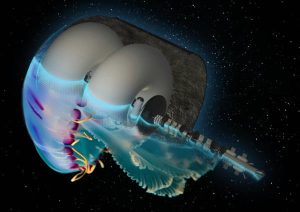
Now this one had me doing a double take – Systema Stellare Proximum, a jellyfish-shaped spaceship carved out of a hollowed-out asteroid. That’s right – they use the asteroid itself as a protective shell.
But what really turns this one from sci-fi to space philosophy is its social system. It’s co-governed by a non-human collective intelligence (yep, AI) and human representatives. And it leaves room for spiritual evolution – the emergence of new belief systems, like space-based neopaganism that honours nature, the stars, and humanity itself.
It’s a proper rethink of society, built for deep space.
It’s Not Just About Surviving. It’s About Thriving.
What I love about all of these concepts is that they go far beyond “how do we not die in space?” Instead, they’re asking: “How do we live beautifully?”
They include everything from floating light shows powered by biogas from the dead (seriously) to wearable culture, art spaces, fluid relationship models, and fully closed-loop food systems.
We’re not just uploading humanity into a spaceship. We’re rebuilding it – thoughtfully, slowly, and with creativity at its core.
Why This Actually Matters (Even If You Never Leave Earth)
Now, you might be thinking, “Cool stuff, but I’m not exactly booking a flight to Alpha Centauri next week.”
But here’s the twist: all this design thinking? It’s not just for space. These generation ships are essentially models for surviving on Earth under extreme conditions – climate breakdown, resource collapse, overcrowding. The thinking behind them is just as useful for designing better cities, buildings, communities and futures right here, right now.
Closed-loop systems. Regenerative agriculture. Emotional resilience. Flexible social structures. These are lessons we’re going to need whether we go to the stars or not.
In a way, these ships are a metaphor. They’re Earth, condensed. A floating microcosm of everything we are and everything we could be – if we get our act together.
Final Wrap: The Real Space Race Is Within
We’ve spent decades dreaming about space as some great escape. But maybe, just maybe, the real goal isn’t to escape Earth – it’s to learn how to be better because we imagine leaving it.
These spaceship designs aren’t just cool visuals – they’re provocations. They ask us to reimagine family, community, food, art, technology and purpose. They challenge us to question what parts of life are essential – and which ones are just baggage.
We might not ever set foot on Chrysalis. But if it inspires us to grow food smarter, live slower, love better, and treat our resources like they matter – then maybe that’s the real mission accomplished.
And honestly, I wouldn’t mind a pair of those big-pocket pants.
Key Takeaways (for all us Earth-bound dreamers)
- Generation ships are real designs, not sci-fi – created for 250-year journeys to distant stars
- Project Hyperion received nearly 100 entries using only current or near-future tech
- Chrysalis features 3D-printed homes, biomes, and a vegetarian lifestyle
- Hyperion has magnetic rings, storage-friendly uniforms, and turtles for longevity
- Systema Stellare Proximum is a jellyfish-ship with AI governance and spiritual rebirth
- Biogas lighting from human remains? Yep, that’s on the list
- Designs rethink family, identity, sustainability, and belief systems
- These ideas are incredibly useful for rethinking life on Earth too
- It’s not just about survival – it’s about living well, wherever we are