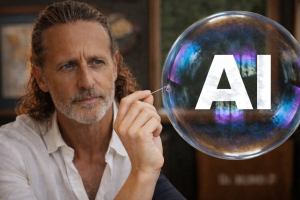
Is AI a Bubble? Or Are We Asking the Wrong Question?
Every few years, a new technology gets big enough that people start whispering the same word.
Bubble.
It happened with the internet.
It happened with crypto.
And now it’s happening with AI.
Scroll your feed and you’ll see headlines warning of collapse, overvaluation, hype cycles, and history repeating itself. At the same time, you’ll see AI tools quietly becoming part of everyday work, creativity, medicine, education, and business.
So which is it?
Is AI a bubble waiting to burst, or something more durable?
After watching the video you shared and looking at what’s actually happening on the ground, the answer turns out to be far more interesting than a simple yes or no.
The real issue isn’t whether AI is a bubble.
It’s whether we’re confusing hype, markets, and technology as if they’re the same thing.
They’re not.
Why Everyone Is Calling AI a Bubble
When people say “AI bubble,” they’re usually reacting to the same handful of signals.
Massive investment.
Huge valuations.
Relentless hype.
Fear of missing out.
Billions are being poured into data centres, chips, cloud infrastructure, and AI startups. Some companies are valued at eye-watering levels long before they generate meaningful revenue. Investors are scrambling to get exposure, sometimes without fully understanding the underlying business.
If that sounds familiar, it should.
Those were exactly the warning signs people saw during the dot-com era.
And visually, the pattern looks similar. Rapid growth, soaring expectations, and a lot of noise.
But this is where the conversation usually goes wrong.
A Market Bubble Is Not the Same as a Technology Bubble
The video makes a subtle but important point that often gets lost in headlines.
Markets can behave irrationally.
Technologies don’t.
The dot-com bubble didn’t mean the internet was fake. It meant valuations were out of control. When the bubble burst, companies collapsed, money disappeared, and a lot of people got burned.
But the internet didn’t vanish.
It quietly became the foundation of everything.
AI is showing similar signs.
There may be excess.
There may be bad bets.
There may even be a correction.
None of that automatically means AI itself is a bubble.
The Part That Is Absolutely Real
Here’s the uncomfortable truth for the “AI is just hype” crowd.
AI already works.
It’s writing code.
It’s editing video.
It’s generating marketing assets.
It’s analysing medical scans.
It’s handling customer support.
It’s changing how people search, write, design, and think.
This isn’t a speculative promise.
It’s already happening.
That alone separates AI from classic bubbles built purely on belief rather than capability.
Where the Bubble Feeling Comes From
At the same time, the sceptics aren’t completely wrong.
There are bubble-like behaviours in the AI space right now.
Some companies are valued more on future potential than current reality.
Some startups exist mainly because “AI” is in the pitch deck.
Some investments loop money in circles between big tech players and the companies they fund.
Some products are little more than thin layers on top of existing models.
That’s not innovation.
That’s opportunism.
And opportunism thrives during hype cycles.
So Is a Correction Coming?
Probably.
Markets don’t move in straight lines forever. Expectations eventually collide with reality. When that happens, weaker companies fail, valuations reset, and attention shifts from “who’s loudest” to “who actually delivers.”
That’s not the end of AI.
That’s the beginning of the next phase.
In fact, if history is any guide, a correction would likely strengthen the space rather than destroy it.
The Dot-Com Lesson Everyone Forgets
The most important lesson from the dot-com era isn’t that bubbles are bad.
It’s that bubbles clear the field.
After the crash, the noise faded.
The gimmicks disappeared.
The serious builders stayed.
And that’s when companies like Google, Amazon, and Facebook truly emerged.
AI is likely heading toward a similar moment.
Not a collapse.
A filter.
The Better Question to Ask
Instead of asking “Is AI a bubble?” a better question is:
Which parts of AI are built on real value, and which are built on hype?
Because those two things will not survive equally.
The tools that save time, reduce friction, increase creativity, and solve real problems will stay.
The companies chasing buzzwords without substance won’t.
That’s not pessimism.
That’s just how innovation matures.
AND thats not even considering the space & electricity issues.
What This Means for Normal People and Businesses
If you’re not an investor, the bubble debate matters far less than people think.
AI tools will keep improving.
They will keep getting cheaper.
They will keep slipping quietly into daily workflows.
Even if markets wobble, AI won’t suddenly stop being useful.
For businesses, creators, freelancers, and everyday users, the smart move isn’t fear or blind excitement. It’s selective adoption.
Use what works.
Ignore what doesn’t.
Stay curious, but grounded.
Final Take
AI isn’t a fake technology riding a wave of delusion.
But parts of the AI market are absolutely overheated.
That combination doesn’t spell disaster.
It spells transition.
The hype will fade.
The noise will thin.
The real tools will remain.
And in a few years, we’ll probably look back and laugh that we ever argued about whether AI was “real” at all.
Quick Recap
AI technology is real and already useful.
Investment behaviour shows bubble-like signals.
A market correction is possible, even likely.
A correction would not mean AI disappears.
The long-term impact of AI is bigger than the hype cycle.
Work, Money and Freedom: Inside the Global Shift Away from 9-to-5 Office Life