Bali’s K-Shaped Economy – Is It Actually a Good Thing?
I was sitting in Canggu the other morning…. at least I was imagining it.
Smoothie bowl. Construction noise. Another villa going up next door.
Across the road? A local warung that hasn’t raised prices in two years because the owner is scared customers will disappear.
Two worlds. Same street.
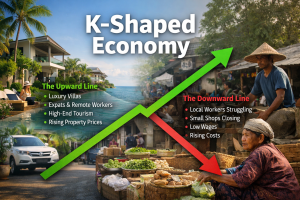
That’s a K-shaped economy.
One line going up.
One line going down.
And Bali right now is a textbook case.
What Does “K-Shaped” Actually Mean?
A K-shaped economy happens when recovery or growth benefits one group…
…while another group stagnates or falls behind.
It’s not a shared rise.
It’s a split.
And Bali? We’re living it.
The Upward Line in Bali
Let’s be honest.
There’s a lot going up.
• Luxury villa development
• Boutique resorts
• Digital nomad hubs
• Premium beach clubs
• Imported food prices (yes, that too)
• Land values in hot zones
Foreign investment is flowing.
Remote workers earning USD, AUD, and EUR are spending in rupiah.
Property prices in areas like Canggu, Uluwatu, and parts of Ubud have surged beyond what most locals could ever realistically buy back.
For asset owners and those positioned well?
It’s boom time.
Some Balinese landowners who sold at the right time made generational money.
Developers are thriving.
Hospitality at the high end is stronger than pre-COVID.
That’s the upward stroke of the K.
The Downward (or Flat) Line
Now step outside the Instagram feed.
Local wage growth has not matched the cost of living.
Ceremonial obligations still exist.
Food, fuel, and rent have climbed.
Younger Balinese who don’t own land?
They’re squeezed.
Small local businesses without a “tourist hook” struggle.
And informal workers are far more exposed to seasonality and global travel dips.
The wealth gap is widening quietly.
That’s the downward stroke.
Zooming Out: Indonesia’s Bigger Picture
Bali is only one province in Indonesia.
Nationally, Indonesia is growing.
Infrastructure is expanding.
Jakarta is relocating to Nusantara. (yeah right – at least it was)
Manufacturing is rising.
Nickel and EV supply chains are booming.
Indonesia overall is on a growth trajectory within Asia Pacific.
But here’s the nuance:
National growth doesn’t automatically equal equal distribution.
Urban centres benefit more.
Export sectors benefit more.
Connected provinces benefit more.
Bali’s growth is tourism-dependent and capital-driven.
When global travel is strong? Up line.
When global shocks hit? Down line hits fast.
Asia Pacific Context (And Australia)
Look at Australia.
Property owners have seen massive capital gains.
Stock markets recovered.
Superannuation funds grew.
At the same time:
Renters are under pressure.
Cost of living is brutal.
Wage growth trails asset growth.
Sound familiar?
Across Asia Pacific, we’re seeing:
• Asset inflation
• Skilled labour premiums
• Urban concentration of wealth
• Rising living costs
Bali is plugged into that system now more than ever.
Foreign money, remote work, crypto cycles, global tourism patterns.
Bali isn’t isolated.
It’s connected.
And that connection amplifies the K-shape.
So… Is a K-Shaped Economy a Bad Thing?
Here’s where it gets interesting.
It’s easy to say, “Inequality is bad.”
And structurally, widening gaps create tension. That’s true.
But…
Growth at the top can also create opportunity at the bottom — if systems are designed well.
High-end tourism can:
• Create jobs
• Fund infrastructure
• Improve roads, airports, hospitals
• Attract global networks
The question isn’t whether growth happens.
The question is who participates in it.
The Real Risk for Bali
If Bali becomes:
Luxury bubble + imported lifestyle + displaced locals
That’s fragile.
If land ownership leaves local hands permanently?
That changes the island culturally, not just economically.
If young Balinese can’t see a pathway upward without selling land or leaving tourism?
That’s a long-term issue.
But if:
Education improves
Digital skills spread
Locals move up the value chain
Entrepreneurship increases
Then the upward line becomes more accessible.
That’s the difference between extractive growth and inclusive growth.
My Coffee Chat Take
Bali’s K-shaped economy isn’t automatically “good” or “bad.”
It’s a signal.
It tells you:
• Where value is concentrating
• Who controls assets
• Who has leverage
• Who is exposed
For foreigners earning offshore income? Bali feels cheap.
For locals earning local wages? Bali feels expensive.
Two realities. Same island.
The Bigger Question
Will Bali evolve into:
A high-end global playground?
Or a balanced ecosystem where locals ride the upward curve too?
Indonesia as a whole is rising within Asia Pacific.
Australia is wrestling with its own asset vs wage divide.
Bali is just a smaller, more visible version of a global shift.
And maybe that’s why it feels intense.
You can see it on one street.
Final Thought
The K isn’t going away.
The only real question is:
Who learns to climb the upper line?
And who gets left on the lower one?
If you’re living in Bali right now…
Which side does it feel like you’re on?
And what would need to change for it to feel more balanced?
Let me know. This one matters.