The upside fantasy…
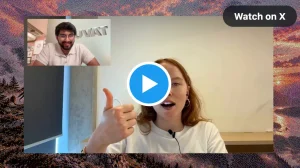
I saw this video recently…. not sure if it was meant to scare us….
Let me say this: I am an AIOptimismist
The Robots Aren’t Coming For Us. They’re Coming To Help Us.
There is something wonderfully cinematic about an army of humanoid robots marching through a factory.
It also makes for a bloody good nightmare.
The video starts with a woman sitting quietly at home, looking at her device. Then we see the machines.
Rows of humanoid robots.
Factories full of them.
Construction sites filled with robotic workers.
Machines becoming increasingly capable.
And finally, the uncomfortable suggestion:
What happens when they no longer need us?
That is the story we keep telling ourselves about AI.
But what if we have got the ending completely wrong?
What if this is actually the good news?
Imagine those same robots doing the jobs humans generally don’t want to do.
Dangerous construction work.
Working inside burning buildings.
Cleaning toxic environments.
Moving heavy objects.
Working overnight in factories.
Exploring places where humans can’t safely go.
Looking after elderly people.
Helping someone with a disability get through their day.
Delivering supplies after a natural disaster.
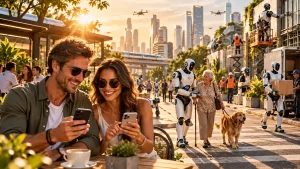
Suddenly, the army of robots looks rather different.
They’re not an invading force.
They’re the world’s biggest workforce upgrade.
And that’s where I think the upside fantasy becomes much more interesting.
We have seen this movie before
Every major technological revolution has created the same fear.
The machine will replace the human.
The printing press would destroy traditional scribes.
Industrial machinery would destroy skilled craftsmen.
The automobile would destroy jobs involving horses.
Computers would eliminate office workers.
The internet would destroy newspapers, travel agents, retail shops and traditional media.
And yes, technology does destroy jobs.
That’s the uncomfortable bit.
But it also creates entirely new categories of work that were difficult, or even impossible, to imagine beforehand.
That’s the bit we tend to forget.
AI may be different — but not necessarily in the way we think
AI can potentially replace parts of many jobs.
That’s real.
But there is an enormous difference between replacing a task and replacing a human being.
A salesperson might use AI to research prospects.
A designer might use AI to create the first concept.
A programmer might use AI to write routine code.
A marketer might use AI to analyse thousands of pieces of data.
A doctor might use AI to identify patterns in medical images.
A teacher might use AI to create personalised learning material.
The human doesn’t necessarily disappear.
The human gets amplified.
And that leads to the catchphrase we keep hearing:
It’s catchy because there is a large grain of truth in it.
The biggest threat may not be AI itself.
It may be the person who learns how to use it better than you do.
The really interesting possibility
Here’s my upside fantasy.
Imagine a world where machines become extraordinarily good at doing the boring stuff.
Not just factory work.
Everything.
Bookkeeping.
Scheduling.
Data entry.
Basic research.
Routine customer service.
Stock management.
Driving.
Cleaning.
Manufacturing.
Administration.
Basic coding.
Translation.
Documentation.
The list goes on.
And humans gradually get pushed towards the things that remain uniquely valuable.
Judgement.
Empathy.
Creativity.
Relationships.
Leadership.
Curiosity.
Taste.
Trust.
Experience.
And perhaps, most importantly…
deciding what is actually worth doing.
That’s not a dystopian future.
That’s potentially an extraordinary one.
The productivity explosion
There is another reason I think the positive outcome is more likely.
Businesses don’t generally buy technology because they want to destroy civilisation.
They buy it because they want to:
Do more.
Do it faster.
Do it cheaper.
Do it better.
If AI and robotics dramatically reduce the cost of producing things, something fascinating happens.
Things that were previously too expensive become affordable.
Services that were previously available only to wealthy people become accessible to everyone.
A small business can suddenly operate with capabilities that previously required a large corporation.
A solo entrepreneur can have an AI powered research department, marketing assistant, designer, programmer and customer service team.
A small farm can use automation that was previously available only to industrial agriculture.
A tiny medical clinic can potentially access sophisticated diagnostic assistance.
That’s not humans becoming irrelevant.
That’s capability becoming democratised.
And there’s another upside we rarely talk about
What if AI doesn’t ultimately make us work more?
What if it helps us work less?
That’s the part I’m particularly interested in.
For decades, technology has promised to save us time.
And somehow we keep finding more things to do.
Email arrived.
Then smartphones.
Then instant messaging.
Then social media.
Then notifications about notifications.
Maybe AI gives us another chance.
Instead of asking:
“How can AI help me cram more work into my day?”
Perhaps we eventually ask:
“How can AI help me get my work done so I can get on with my life?”
Now that would be progress.
Why I think the positive outcome is the most likely
I’m not saying there aren’t risks.
There absolutely are.
AI will disrupt jobs.
Some businesses will disappear.
Some skills will become less valuable.
Some people will make enormous mistakes with powerful technology.
Governments will struggle to regulate it.
There will be bad actors.
There will be accidents.
And there will undoubtedly be some spectacularly stupid uses of AI.
But there’s a reason I’m optimistic.
Humans are extraordinarily adaptable.
We have repeatedly taken technologies that initially looked threatening and eventually incorporated them into everyday life.
The technology changes.
We adapt.
The jobs change.
We adapt.
The skills change.
We adapt.
And perhaps most importantly, humans are incredibly good at finding things to do once our basic needs are taken care of.
Give us more free time and we’ll create.
We’ll build.
We’ll entertain ourselves.
We’ll start businesses.
We’ll make art.
We’ll travel.
We’ll complain about something on Facebook.
We’ll find a way.
That’s what humans do.
The robots may actually give us more humanity
There’s a delicious irony here.
The more capable machines become at being machines…
the more opportunity we may have to concentrate on being human.
Perhaps the future isn’t humans versus robots.
Perhaps it’s humans with robots.
Not an army marching down the street.
But a machine quietly doing the job that would otherwise have taken you six hours.
Not AI replacing your business.
But AI allowing one person to build a business that previously required ten.
Not technology taking away your life.
But technology finally giving some of it back.
And if that’s where we’re heading…
I’m rather optimistic about the future.
Because the most likely outcome isn’t that the machines become more human.
It’s that humans become freer to be human.
And personally, I’ll take that version of the future.
If You missed Part 1
https://markwhitby.me/what-if-the-ai-apocalypse-is-actually-good-news/