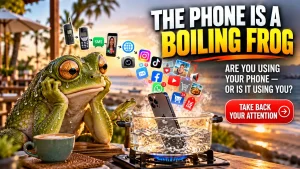
The Phone Is a Boiling Frog
Remember when having a phone meant someone could call you?
That was pretty much it.
You carried it around because you wanted to be reachable. Someone called. You answered. Perhaps you called someone back.
Simple.
Then, almost imperceptibly, we turned the humble telephone into the most sophisticated attention harvesting device ever placed in our pockets.
And here's the strange bit.
We did it ourselves.
One little feature at a time.
It Started Innocently Enough
First, we had the mobile phone.
A marvellous little device that meant you could make and receive calls wherever you happened to be.
Then came SMS.
“Hey, where are you?”
Useful. Convenient. Harmless enough.
Then came cameras.
Suddenly the phone wasn't just something you talked into. It was something you could use to capture the world around you.
Then came video calls.
Brilliant.
Now we could see the person we were talking to.
Then came the Internet.
And that's when things started getting interesting.
The Phone Became a Smartphone
We stopped calling it a phone.
We called it a smartphone.
And, to be fair, it deserved the name.
It could browse the web, send email, play music, navigate us around town, check the weather, translate languages, take photographs, record video, manage our calendars and occasionally tell us that we'd left our keys somewhere stupid.
Fantastic.
But then somebody had another idea.
“What if we could put social media on it?”
And we thought that sounded like a great idea.
From Communication Device to Entertainment Centre
Suddenly the phone became a picture-sharing device.
Then a video-sharing device.
Then a news reader.
Then a shopping centre.
Then a television.
Then a gaming console.
Then a banking terminal.
Then a dating service.
Then a workplace.
Then a GPS tracker.
Then a personal assistant.
Then an AI assistant.
And somewhere along the way, we stopped asking:
“What do I want to do with my phone?”
and started responding to:
“What does my phone want me to do?”
Welcome to the Attention Economy
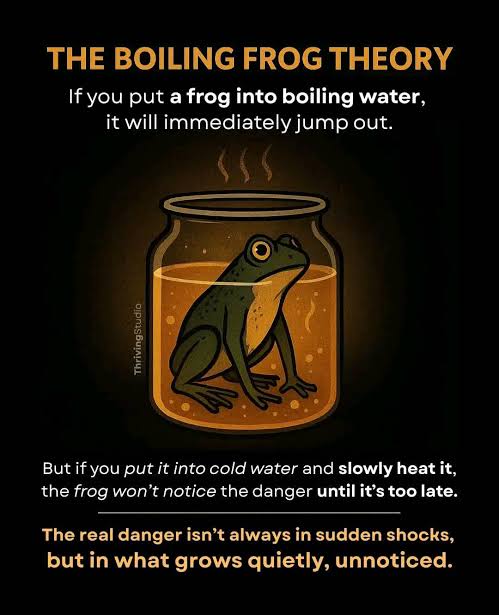
This is where the boiling frog analogy gets interesting.
None of these individual developments necessarily seemed dangerous.
SMS was useful.
Facebook was useful.
Instagram was fun.
YouTube was entertaining.
TikTok was entertaining.
Email was productive.
Notifications were convenient.
Push notifications were supposed to make life easier.
And they did.
Until we realised that the companies creating many of these services weren't simply giving us tools.
They were competing for something much more valuable.
Our attention.
The Phone Doesn't Ring Like It Used To
Here's the irony.
We invented the mobile phone because we didn't want to miss calls.
Now many of us actively avoid answering the phone.
Not because we don't want to talk.
Because we're already overwhelmed.
The phone rings and we wonder who wants something.
A message arrives and we wonder what needs responding to.
An email appears.
A WhatsApp notification pops up.
Someone comments on something.
Someone likes something.
Someone sends a reel.
Someone tags us.
Someone wants us to watch something that apparently cannot wait another 14 seconds.
And then, just when we think we've caught up…
Another notification.
We Didn't Notice the Temperature Rising
That's the clever part of the boiling frog.
The temperature doesn't suddenly go from comfortable to unbearable.
It changes gradually.
Our relationship with the phone did exactly the same thing.
We didn't wake up one morning and decide:
“Today I'm going to carry a tiny computer around with me all day, check it hundreds of times, allow dozens of companies to compete for my attention and occasionally panic when I can't find it.”
No.
We added one useful feature.
Then another.
Then another.
And another.
Until the thing that was originally designed to help us communicate became something that constantly interrupts us.
The Phone Is No Longer Just a Tool
That's the fundamental shift.
A hammer doesn't send you a notification reminding you to hit another nail.
Your refrigerator doesn't suggest that you watch a video before opening the door.
Your toaster doesn't interrupt breakfast because somebody you vaguely know just posted a photograph of their lunch.
Tools generally wait for us.
Our phones increasingly don't.
We Are Now Managing the Phone
Think about that for a moment.
We used to use the phone to manage our lives.
Now we spend a surprising amount of our lives managing the phone.
Mute this.
Delete that.
Check this.
Reply to that.
Update the app.
Charge the battery.
Find the phone.
Check the phone because we think we heard it.
Check the phone because we didn't hear it.
Check the phone because we're bored.
Check the phone because we're not bored.
Check the phone because…
Well, apparently checking the phone has become something we do when we don't know what else to do.
And Here's the Really Clever Bit
The phone doesn't actually have to force us to use it.
It simply has to become sufficiently interesting.
That's much more powerful.
If someone physically grabbed your arm every five minutes and said, “Look at this!” you'd probably get annoyed.
But when the phone quietly buzzes in your pocket?
We reach for it ourselves.
We've been trained to respond.
I'm not suggesting we throw our phones into the ocean.
Although, depending on the day, that can have a certain appeal.
The smartphone is an extraordinary tool.
I use mine constantly.
The problem isn't the technology.
The problem is allowing somebody else's business model to determine how much of our attention they get.
So perhaps the answer isn't becoming a digital hermit.
Perhaps it's simply taking back control.
So What Do We Do About It?
Turn Off the Noise
Do you really need notifications from every app?
Probably not.
Choose When You Check
You don't have to respond to everything the moment it appears.
Make the Phone Boring Again
Remove the apps that constantly demand attention.
Keep the tools that genuinely make your life easier.
Remember What It Was For
Your phone is a tool.
It is not your boss.
It is not your social director.
It is not your entertainment manager.
And it certainly shouldn't be deciding what you think about next.
The Frog Is Already Sitting in the Pot
Maybe the biggest lesson isn't that smartphones are bad.
They're not.
They're extraordinary.
The lesson is that gradual change is incredibly easy to accept.
One small addition doesn't seem significant.
Neither does the next one.
But eventually you look around and realise that something that began as a simple communication device has become the remote control for an enormous chunk of your life.
And perhaps that's the moment to stop.
Take it out of your pocket.
Look at it.
And ask a rather uncomfortable question:
“Am I using this thing, or is this thing using me?”
Because here's the punchline:
The phone didn't suddenly become a boiling frog.
We just kept adding features until we didn't notice the water was getting hot.
And unlike the frog…
we can actually turn the bloody thing off.