
Note: This post is inspired by: Fiasco da Gama – See the video and links below. All the words and thoughts are his, however It could have been me with some dates n places changed. I am coming up to 25 years of Digital Nomadery. So inspiring… read, listen or watch!
My suggestion, listen to the video audio while you read the text….
What 40 Years on the Road Taught This Old Traveller About Money
Quick Read TL;DR
Money is a tool, not the destination. The argument here is that waiting until 67 to enjoy life can mean arriving with plenty of money but less health, energy and curiosity. Travel and life experience create a different kind of wealth: memories, resilience, adaptability and perspective. But ignoring financial security has its own cost. The answer isn't choosing between being broke and being wealthy. It's finding a way to live now while still building enough financial security for later.
We're Taught to Worship the Future
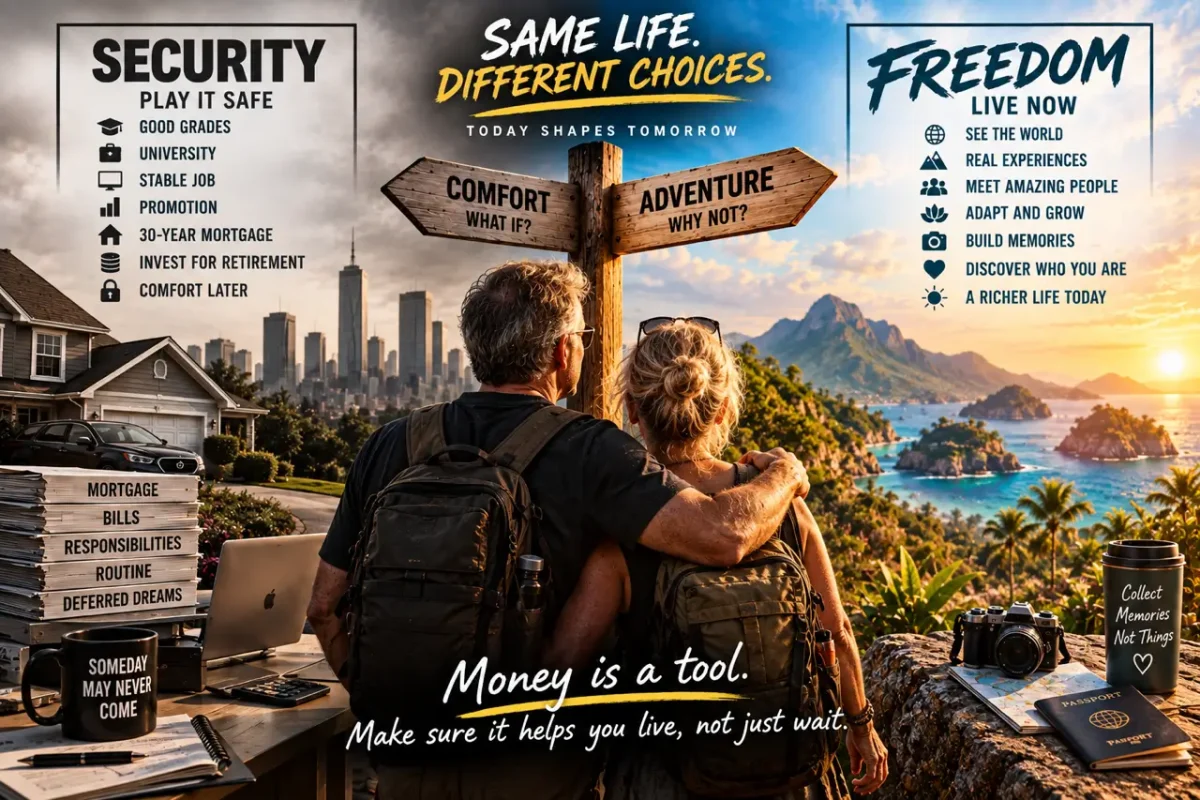
We're taught to worship the future. We're conditioned to trade the present for a promise of tomorrow. Get good grades. Go to a good university. Get a good, stable job. Work that job so you can get promoted. Get promoted so you can buy a home with a 30-year mortgage. Then drop 20% of your pay into a share portfolio to give you back your freedom when you turn 67.
It's an efficient system. It builds roads, runs financial institutions, keeps markets humming along, and fills the suburbs with lovely manicured lawns and white picket fences. But it's a gamble that you'll actually live to enjoy the dividend. And that when you finally collect it, you'll still be the same person you were when you put your money in.
Your Body Has a Shelf Life
When you're 25, 30, or 35, your body's strong. You can sleep on a wooden train seat in India, wake up with a stiff neck, and spend the next 12 hours walking around New Delhi in 45°ree heat. You have a high tolerance for discomfort, and your capacity for awesomeness is at its peak. Now, fast forward 40 years. You played it safe. You worked the hours.
You signed the papers. You watched your interest grow and paid off the house. Now, you're 67 years old. You have $2 million sitting in investment portfolios. And you are, by every standard of modern Western society, an unqualified success. So, you book the trip to Italy and spend $400 a night on a boutique hotel with really nice sheets and gorgeous staff.
But your knees ache when you walk down cobblestone streets. You need three different medications taken at precise times of the day with food. You get tired by 2:00 in the afternoon. And the crowd at the museum makes the place feel like an endurance obstacle weightlifting double pole vaultting marathon. >> You have all the money in the world, but your body has broken down.
And you're also starting to lose your hotel keys more than you did. You deferred your gratification and in doing so let the value of experience sit and rot in the corner. Experience has a shelf life. You aren't going to have flexible hips and a full grasp of your marbles forever. When you spend your early or middle years choosing life of travel, choosing to move through the world rather than sit still and build a financial castle, you're taking your capital and converting it into a different kind of interest. You're accumulating a different kind of payoff or dividend.
The Dividend of Experience
A memory made at 25 doesn't just exist on the day it happens. You carry that memory for 50 years. It becomes part of the lens through which you view a news event, >> a book you read, strangers you meet in the street. >> It gives you a perspective that prevents you from [clears throat] panicking when things fall apart because you've already experienced total failure in a country and a language you didn't speak in a town that wasn't on the map with night falling fast in the rain. This type of thing builds self-reliance. You can look after yourself. If you lose your job tomorrow, your financial security is cracked. >> But if you've lived a bit, if you've really lived, your identity is unshakable. You know who you are. You realize you're not your job title. You're not your zip code, and you're not your consumer conveniences.
You're an adaptable, capable person in a pretty complicated world. I hear the people up the back shouting, “That's romantic nonsense, mate. Romance doesn't pay for your medication when you're 75 years old. It doesn't cover the rent when your body gives out and you can't stand for eight hours a day.
The Real Cost of Choosing Experience
It doesn't buy dignified healthc care in a world that shows no mercy to broke people. And that voice isn't wrong. That's the weight of the tradeoff. To choose a life of travel, of constant experience, movement over money, is to accept a very real risk. You won't have the property that your peers have built while they stayed in one place for 30 years.
You won't have the pristine corporate resume that makes HR managers feel safe. You'll have gaps. You'll have years where you barely made enough money to cover an Air Asia flight and a hostile bed in K cover. When you're old, you'll look around and realize that society does not treat poor elderly people with tenderness.
Without a financial cushion, old age can be brutal. In the USA, if you develop a chronic health condition, you can't pay your medical bills with stories about watching the sunrise over anchor. What? You can't hand a landlord a photograph of yourself eating a great pad thai on Coan Road. The fear of that vulnerability is what keeps most people glued to the desks that they hate, living in towns they find dull, doing work that mindnumbingly repeats itself week after week, year after year.
It's a completely rational fear. Security is comfort, peace of mind, and protection from physical suffering. So, how do we weigh these two? On one side lies the risk of wasting your youth, trading the only guaranteed vitality you'll ever possess for an abstract future that may never arrive, or arriving there too broken and tired to use it or care.
You Don't Have to Choose Between Two Extremes
On the other side lies the risk of squandering your age, spending your early years in a blaze of travel glory only to find yourself old, exhausted, broke, and dependent on a society that has no patience for anyone who didn't plan ahead. So what do we do? What do we choose? We act as if you must choose between two extremes.
Either you're an irresponsible nomadic vagabond living hand-to-mouth until you fall apart in your 60s, or you're a hyper cautious financial monk who starves their soul today so their future self can sit comfortably in a luxury nursing home. The reality is that the world has changed. The strict boundary between building security and exploring the world has dissolved, if you're willing.
Living a life of experience no longer requires you to throw your financial future off a cliff. We don't live in 1985. We live in an era of global connectivity and remote infrastructure. You don't have to choose between earning a living and seeing the world. You can build a skill set that travels with you. You can earn in a strong currency while spending in a lowerc cost economy.
Living a life of richness while quietly tucking away capital for the long haul. Choosing life experiences forces you to radically redefine what security actually is. Is security really a high net worth and a house full of expensive objects that you have to pay to ensure clean, heat, and protect? Is security a set of golden handcuffs that bind you to a routine you hate because you've scaled your lifestyle to match your salary? Or is security knowing you can land in any city on Earth with $500 in your pocket, zero connections, and no understanding
What Does Security Really Mean?
of the local language, and find a way to eat, find a roof, make a friend, and thrive. The old way tells you that if you follow the rules, sign the contracts, and stay in line, the system will keep you safe. But there's no guarantee of that promise. The traveler, the seeker, the person who traded stability for life experience knows that structures are temporary by nature.
They've spent their entire life adapting to shifting circumstances, misconnections, changing weather, and unexpected detours. Security is wired into our nervous system. We know how to survive. Consider the cost of the alternative. Millions of people walk through life quietly. They buy things they don't need to impress people they don't like.
The Problem With “Someday”
Comforting themselves with the promise that someday, someday when the mortgage is paid, someday when the kids are grown, someday when the share portfolio hits a certain number, they'll start to live then. But someday is a tricky word. It seems to move all the time. The posts keep shifting. The person who couldn't step away from the desk at 30 often finds that by 60 they've lost the ability to step away at all. They've become institutionalized.
When you're laying on your deathbed, and every single one of us will, whether in a high-end private hospital suite or in a simple room in a quiet village halfway across the world, what's the ledger going to show? I don't think you'll remember the financial quarterly performance reviews. You probably won't care.
Your credit score reached 800 or whatever a high credit score is. You'll remember the light coming through an old cathedral in a country whose name you could barely pronounce when you bought the ticket. You'll remember the cold sea spray on your face as you cross a stretch of open water toward an island with no electricity.
Money Is a Tool
You'll remember the laughter shared over a cheap meal with people whose lives were completely different from yours. Money is a tool, a really useful tool, but it's a tool designed to help life, not replace it. To spend your entire existence hoarding money at the expense of building a life is misunderstanding the assignment. I think if you choose comfort, don't choose it out of fear of the unknown.
And if you choose travel and experience, choose it with your eyes open, knowing that it demands sacrifice and a willingness to embrace a lot of uncertainty. In the end, you're going to pay a price. There's no escaping from the tax of life. You'll either pay the price of insecurity, unpredictability, and financial risk today, or you'll pay the price of regret, and unfulfilled curiosity tomorrow.
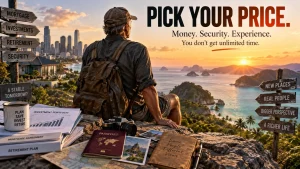
Pick your price. Pick your sacrifice. But whatever you do, don't let life be something that simply happened to you while you were busy making safe plans for a tomorrow that's never guaranteed to arrive anyway.
Original Video:
Waynes Channel: https://www.youtube.com/@fiascodagama1


4 Responses
Did this resonate with you? Have we been sold the wrong dream?
That was certainly interesting way of looking at things. I agree with you , tomorrow is never promised. I will chat to you more about this.
That was certainly interesting way of looking at things. I agree with you , tomorrow is never promised. I will chat to you more about this.
That was certainly interesting way of looking at things. I agree with you , tomorrow is never promised. I will chat to you more about this.