AI Revolution: How I Use Google Has Changed
Something happened to me recently.
I realised I don't really search Google the way I used to.
And when I stopped to think about it, the change was actually pretty dramatic.
It happened so quickly that I almost didn't notice.
I Used To Search
For years, my Google behaviour was pretty predictable.
I'd type in a few keywords.
Maybe:
- “best WordPress caching plugin”
- “how to fix PHP memory limit”
- “alternative to Mailchimp”
- “what does this error mean?”
- “how do I connect this to that?”
Then I'd get a page full of results.
I'd scan the titles.
Click a few links.
Open several tabs.
Read the articles.
Compare the information.
Try to work out which source I trusted.
Then I'd probably go back to Google and refine the search.
And repeat.
That's just how we used the internet.
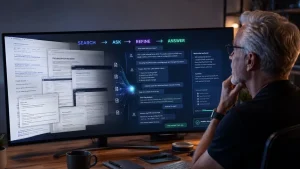
Search → click → read → compare → decide.
But I don't do that nearly as much anymore.
Now I Ask
These days, my searches look much more like conversations.
Instead of searching for:
“WordPress image optimisation plugins”
I'll ask:
“What's the best way to optimise images in WordPress without slowing down my site?”
Instead of:
“Mailpoet alternatives”
I'll ask:
“What's a good alternative to Mailpoet for a small business with a simple email list?”
Instead of:
“What is this WordPress error?”
I'll paste the error in and ask:
“What does this mean and how do I fix it?”
See the difference?
I'm not really searching for information anymore.
I'm asking for an answer to a problem.
And that's a pretty fundamental change.
This Is Especially Interesting For Me
As The Internet Whisperer & someone who has spent decades working with technology, websites, WordPress, online marketing and all the wonderful chaos that comes with them, I've always had one particular advantage.
I don't know everything.
Not even close.
But I generally know where to find the answer.
That's been one of my most useful skills for a very long time.
I don't need to remember every WordPress setting.
I don't need to know every plugin.
I don't need to know every technical solution.
I just need to know how to work out what's going on and where to look next.
AI has changed that equation.
Now I can often ask the question directly.
And then ask another question about the answer.
And another.
And another.
It's Interactive
This is the bit that really blows my mind.
Google search was essentially:
You ask → Google searches → Google gives you results -> deep reading -> maybe the answer -> repeat
AI is:
You ask → AI answers → you clarify → AI adjusts → you ask again → AI refines the answer.
It's interactive.
It's iterative.
It's a conversation.
And that makes a massive difference.
I can say:
“That's not quite what I mean.”
And explain what I actually want.
I can give it more information.
I can challenge the answer.
I can ask for alternatives.
I can ask it to explain something in simpler language.
I can say:
“Okay, but what would you recommend for someone who isn't technical?”
And it can continue from there.
That's fundamentally different from searching a list of web pages.
I Don't Even Click The Links Much Anymore
This is probably the biggest behavioural change I've noticed.
I often don't click the search results.
I'll get the information I need from the AI response.
And if I do need something specific, I'll ask for it.
“Show me the source.”
“Find the official documentation.”
“Give me the link.”
“Check the latest version.”
But I'm no longer automatically opening ten browser tabs and working my way through them.
And increasingly, I don't even read the documentation myself.
AI has already read it.
I can ask:
“Read the documentation and tell me what I actually need to do.”
That's incredibly powerful.
Particularly when the documentation is 40 pages long and I'm looking for one tiny piece of information.
And It Knows The Context
This is another huge difference.
Traditional search doesn't really understand me.
It understands the words I typed.
AI can understand the question in context.
I can explain what I'm trying to achieve.
I can tell it what I've already tried.
I can tell it what technology I'm using.
I can give it the error message.
I can tell it what I'm worried about.
And then it can use all of that information when working through the problem.
It's not simply finding an answer.
It's helping me work through the problem.
And Yes… It Can Still Get Things Wrong
Before someone jumps into the comments with:
“But AI hallucinates!”
Yes.
It can.
I'm not pretending otherwise.
That's why you still need to think.
You still need judgement.
You still need to verify important information.
And you absolutely shouldn't blindly trust anything an AI tells you.
But here's the thing I've noticed in my own use.
For the everyday technology questions I ask, I find the answers remarkably useful.
I'd estimate that I'm getting what I need 99% of the time.
Not necessarily a perfect answer.
But usually enough to move the problem forward.
And when it isn't right?
I ask another question.
That's the really important part.
AI Doesn't Replace Knowing
This is where I think people sometimes misunderstand what's happening.
AI doesn't mean I suddenly know everything.
Quite the opposite.
I still don't know everything.
What has changed is the friction involved in finding things out.
For years my advantage was:
“I don't know, but I know where to find out.”
Now it's becoming:
“I don't know, but I know how to ask.”
That's a subtle difference.
But it's a HUGE one.
Oh My God… It Happened Quickly
This is the bit I keep coming back to.
OMG.
It happened so quickly.
Not the invention of AI.
The behavioural change.
One minute I was searching Google.
The next minute I was asking AI.
And I didn't really make a conscious decision to change.
I just started doing it.
More and more.
Until suddenly I realised:
I don't use Google the same way anymore.
Google hasn't disappeared.
Search hasn't disappeared.
The web hasn't disappeared.
But the way I use all of them has changed.
And I suspect we're only at the beginning.
And It's Much More Efficient
This might actually be the biggest benefit.
Efficiency.
Instead of:
Search.
Click.
Read.
Back.
Search again.
Click.
Read.
Compare.
Try something.
Search again.
I can often do:
Ask.
Read.
Clarify.
Ask again.
Done.
That's a completely different workflow.
And for someone who spends a lot of time helping other people with technology, that's potentially enormous.
I don't need to know every answer.
I need to understand the problem.
I need to ask the right questions.
And I need to know when an answer makes sense.
That's still human.
Perhaps more human than ever.
Because the valuable skill is moving away from knowing where the information is and towards knowing what to ask for and then how to impliment it.
And that is a fascinating change.
Oh My God!
I think I need to think about this one a bit more.
I will ponder the why and write more later… The Internet Whisperer will be implementing.