Stop Sharing First. Start Thinking First.
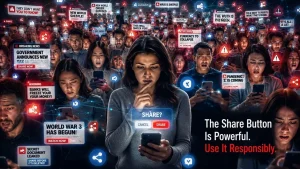
Every day, social media is flooded with alarming posts.
A new law is coming.
The banks are collapsing.
The government is taking your money.
A virus is spreading.
A foreign country is about to invade.
A celebrity has died.
A new tax is being introduced.
Most of the time, people don’t stop to ask a simple question:
“Is this actually true?”
Instead, they hit the Share button.
The result is predictable.
Thousands of people see the post.
Hundreds become concerned.
Dozens become angry.
Some begin spreading it even further.
Before long, a rumour has become a movement.
The problem isn’t always the person who created the misinformation.
Often, the bigger problem is the well-meaning people who spread it.
The Hysteria Machine
Social media rewards emotion.
Fear spreads faster than facts.
Outrage spreads faster than evidence.
A calm, balanced explanation might get a handful of reactions.
A dramatic claim that the sky is falling can get thousands.
The algorithms don’t care whether something is true.
They care whether people engage with it.
That means every share, comment, angry reaction, and argument helps amplify the very content many people claim they oppose.
“But I Was Just Sharing It”
This is one of the most common excuses.
People often say:
“I don’t know if it’s true, but…”
Or:
“Sharing in case it’s real.”
Imagine applying that logic in everyday life.
You wouldn’t tell your neighbours their house was on fire just because somebody sent you a message saying it might be.
You wouldn’t tell everyone the local bank had collapsed without checking first.
Yet online, many people do exactly that.
The Real-World Consequences
Misinformation isn’t harmless.
False health information can cause people to avoid treatment.
Fake financial rumours can create unnecessary panic.
Political misinformation can divide communities.
Local rumours can damage businesses and reputations.
Even when a story is eventually proven false, the correction rarely spreads as far as the original claim.
The damage is often already done.
A Simple Rule
Before sharing anything online, ask yourself:
- Who originally published this?
- Is there a credible source?
- Has it been independently verified?
- Am I sharing facts or emotions?
- Would I stake my own reputation on this being true?
If the answer to any of those questions is uncertain, don’t share it.
It’s that simple.
We Need More Skepticism
Healthy skepticism is not cynicism.
It’s not refusing to believe anything.
It’s simply refusing to believe everything.
The internet gives every person a publishing platform.
That means every person also carries some responsibility.
A share button may seem harmless, but every click contributes to either better information or more confusion.
The Bottom Line
The world doesn’t need more panic.
It doesn’t need more outrage.
It doesn’t need more people forwarding rumours because they sound dramatic.
What it needs is more critical thinking.
Before you share the next shocking post, take sixty seconds to verify it.
Because misinformation only spreads when ordinary people help it travel.
And the easiest way to stop the hysteria machine is to stop feeding it.